How the Hybrid System Works in WEC Hypercars
Recovering energy is not the same as deploying it at any time: the Hypercar’s architecture and regulatory limits dictate when the electric motor can be used.
Key points
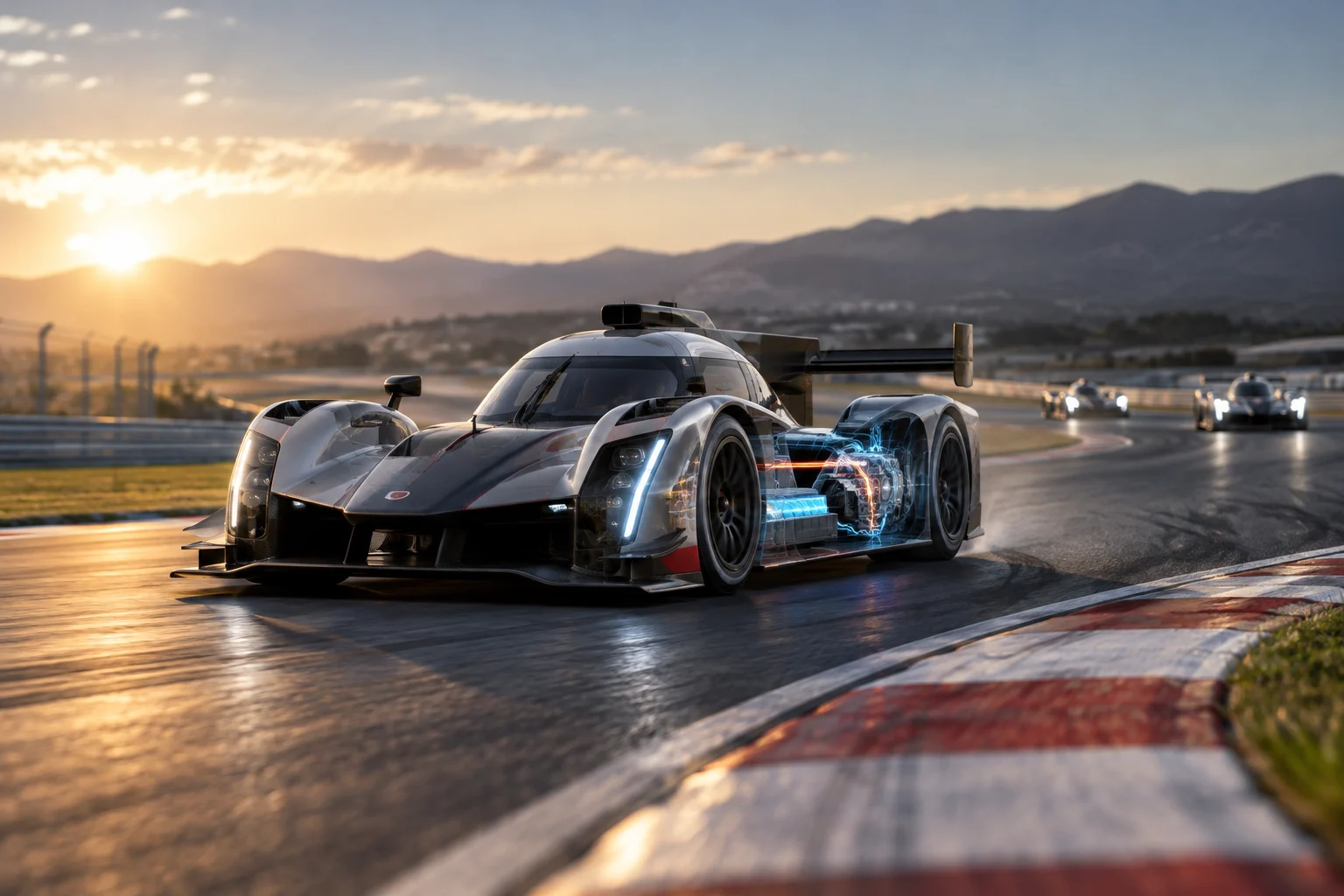
WEC Hypercars combine a combustion engine with an electric system that can recover and deploy energy. The timing and amount of power available depend on the car’s architecture and the regulations for each season.
Recovering and Deploying Energy Are Separate Phases
A hybrid Hypercar combines a thermal engine with an electric system that can recover energy and return it to the wheels. The key idea is that this is not an unlimited reserve: the available energy, combined power and conditions for using the electric motor are constrained by regulations and each car’s design.
In simple terms, recovery turns part of the car’s energy into electricity and stores it; deployment uses that electricity to add torque to the wheels. The control system coordinates both phases with the combustion engine, so hearing about "regeneration" does not mean the car can accelerate electrically at will on any section.

How Energy Is Recovered During a Race
In the hybrid systems described for LMDh, regeneration can act on the rear axle and recharge the battery. A significant portion occurs during braking when the electric system works to recover energy; it can also happen in a straight line. The amount and method depend on the system’s configuration.
It is not appropriate to generalize this mechanism to all Hypercars. The Porsche 919 Hybrid, a prototype from an earlier era, also recovered energy through a turbine in the exhaust while accelerating. It illustrates that technical solutions can differ; it is not a description of current cars in the category.
Section references: Llegan los LMDh: así funciona su curiosa tecnología híbrida ↗ · Le Mans y los híbridos del futuro ↗

Regulations Limit Energy and Power
The strategy is not just to charge the battery as much as possible. Rules can limit both the maximum power of the overall system and the energy allowed to be used in a race stint. Thus, teams must manage when to recover and when to spend, keeping performance within regulatory parameters.
Figures change with category, regulation and season. For example, a source on LMDh/GTP from IMSA cites a total power limit of 500 kW at the rear wheels and an energy per stint limit of 920 MJ. These are data for that specific framework, not automatic limits for any WEC Hypercar.
Historical rules also differed: for Le Mans in 2017, an invertible electric energy of 2.2 kWh per lap was described. That reference should not be confused with the current regulation. To interpret a figure from a broadcast or spec sheet, first verify the season, category and championship it applies to.
Section references: Llegan los LMDh: así funciona su curiosa tecnología híbrida ↗ · Le Mans y los híbridos del futuro ↗
When the Electric Energy Is Deployed
Recovered energy is used to supplement thermal propulsion where strategy and rules allow. Coordination can help meet acceleration needs, but it does not mean the electric motor always intervenes under the same conditions or that all cars deliver power in the same way.
In LMH described by a technical source, the MGU‑K is mounted on the front axle and its positive contribution to the front wheels is subject to speed thresholds and tire‑related conditions. This is a specific example of that architecture, not a universal rule for any WEC hybrid car. The location of the electric system, its limits and activation conditions can vary between concepts.
Section references: Le Mans Hypercar - Wikipedia ↗
What to Check in Technical Sheets
Before comparing hybrid system figures, identify whether the source discusses LMH or LMDh, WEC or IMSA, and which season. A figure may describe a regulatory limit, component power or overall maximum; they are not interchangeable magnitudes.
To understand a specific car’s operation, check the technical regulation and official season documentation for where the motor‑generator sits, which axle it drives, how energy is recovered and what limits govern deployment. In particular, do not extrapolate historical system details like the Porsche 919 Hybrid to the current category.
You can expand context in Technology and Recreation and Competition.
- Identify season, championship and class before applying a figure.
- Distinguish maximum power, recoverable energy and energy allowed per lap or stint.
- Treat a car’s architecture as a specific case, not a description of all Hypercars.
Do all WEC Hypercar hybrids recover energy in the same way?
No. Architecture and method can vary. In described LMDh, regeneration may act on the rear axle; the historic Porsche 919 Hybrid also recovered energy via an exhaust turbine.
Can recovered energy be used at any time?
Not necessarily. Deployment is conditioned by regulatory limits and car configuration; some architectures also specify activation conditions.
Are 920 MJ per stint and 500 kW common limits for all WEC Hypercars?
No. Those figures refer to LMDh/GTP under the IMSA framework cited in the source. Limits depend on category, championship and season.