Open Differential in Cars: How It Works and What Happens When a Wheel Skids
Understand the role of an open differential in your vehicle: why it’s essential for cornering and how it can limit traction when a wheel loses grip. Learn to distinguish it from limited-slip and electronic traction control systems.
Key points
An open differential allows driven wheels to rotate at different speeds during a turn, which is essential for stability and tire longevity. However, it directs torque to the wheel with less resistance, which can limit traction if one wheel loses grip on slippery surfaces. This is a standard design feature, not a mechanical fault.
What Is a Differential and Why It’s Needed
A differential is a mechanical component located on the vehicle’s drive axle. Its main function is to allow driven wheels to rotate at different speeds, which is essential when a car takes a turn. When turning, the outer wheel travels a greater distance than the inner one; without a differential, the wheels would be forced to rotate at the same speed, which is mechanically incompatible with the geometry of a turn.
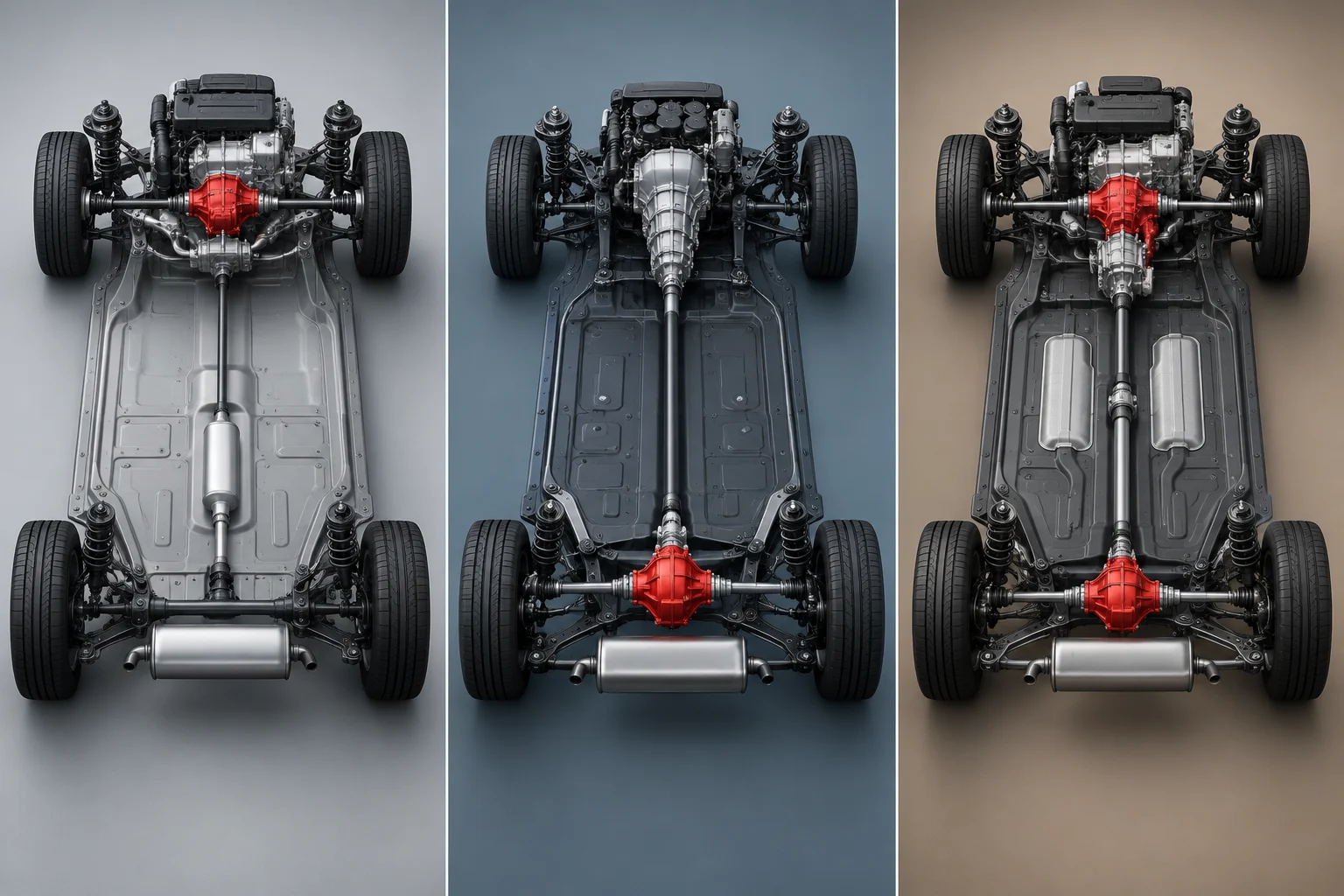
Mechanically, the differential is found on the front axle in front-wheel drive cars, on the rear axle in rear-wheel drive vehicles, and on both axles in all-wheel drive systems. In the latter case there may be several differentials: front, rear and a central one to distribute torque between the axles.
Section references: Diferencial | Glosario de Nissan ↗ · Diferencial del coche: qué es, cómo funciona y por qué es importante en Gran Canaria ↗
- Allows speed difference between wheels in a turn.
- Improves stability, traction and grip.
- Located on the drive axle(s) depending on drivetrain type.
How an Open Differential Distributes Motion
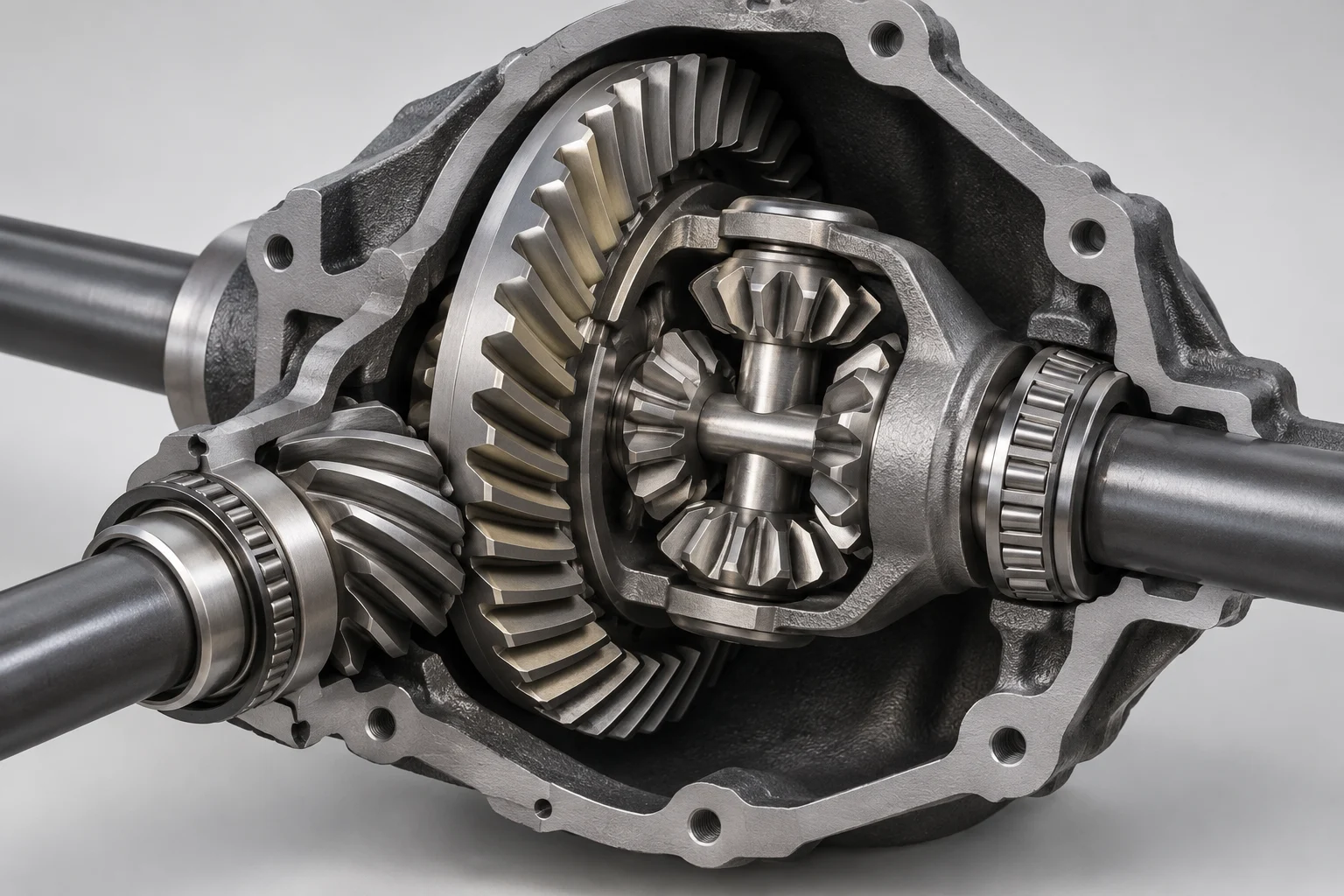
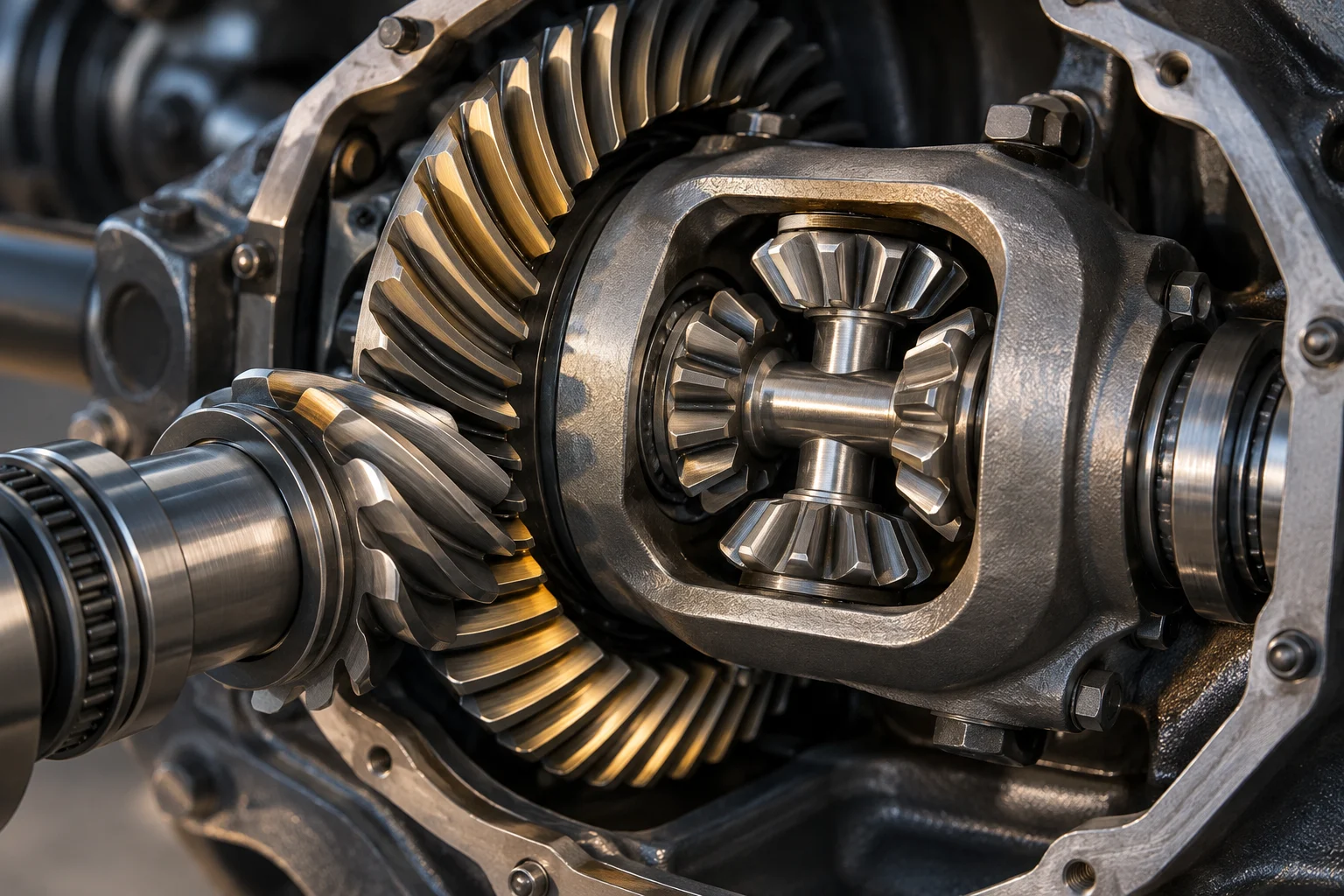
The open differential is the most common type in the automotive industry. Its basic structure includes three key elements: the pinion, the ring gear and the satellite or planetary gears. When a car moves straight, engine torque is evenly split between both wheels on the axle.
In a turn, the satellite gears allow the outer wheel to rotate faster than the inner one. This mechanism is simple and effective for everyday use, ensuring that the vehicle can turn without tires dragging or wearing abnormally.
Section references: Diferencial | Glosario de Nissan ↗
- It’s the standard system in production cars.
- Uses satellite gears to split speed.
- Operates passively, without electronic intervention.
What Happens When a Driven Wheel Has Less Grip
This is the main limitation of an open differential. Its operation is simple: it sends power to the wheel with less resistance. This means that if a wheel loses grip—for example on ice, mud or loose gravel—it receives more torque while the wheel with traction receives less.
The result can be a loss of traction during hard acceleration or on slippery surfaces. The car may struggle to move forward because torque is directed to the wheel with less resistance, preventing enough force from reaching the gripping wheel to propel the vehicle.
Section references: Este vídeo descifra la magia del interior de uno de los mejores avances en los coches: el diferencial de deslizamiento limitado ↗ · Cómo funciona un diferencial autoblocante y por qué mejora la tracción ↗
- Torque is directed to the wheel with less resistance.
- The gripping wheel receives less force.
- It can hinder movement on slippery surfaces.
Open, Limited-Slip Differentials and Electronic Aids
To mitigate the limitation of an open differential, limited-slip differentials (LSD) were developed. These systems are designed to limit the speed difference between wheels when one loses grip, transferring more torque to the wheel with better traction. They are common in 4x4s, off-roaders and sports cars.
There is also a lockable differential used in off-road vehicles, which forces both wheels to rotate at the same speed to overcome difficult terrain. Many modern cars also use electronic traction control aids that act on the brake of the slipping wheel to simulate a lock-up effect. These electronic systems are distinct from mechanical differentials and work in conjunction with them.
| System | Primary Function | Typical Use |
|---|---|---|
| Open | Allows different speeds in a turn | Daily use, dry asphalt |
| Limited-Slip (LSD) | Limits speed difference and transfers torque to the gripping wheel | Sports, 4x4, off-road |
| Lockable | Forces same speed on both wheels | Extreme off-road |
| Electronic Traction Control | Brakes the slipping wheel to improve traction | Standard cars with ESP/ASR |
Section references: Diferencial | Glosario de Nissan ↗ · ¿Qué es el diferencial de un coche? ↗ · Cómo funciona un diferencial autoblocante y por qué mejora la tracción ↗
- Limited-Slip (LSD): Transfers torque to the wheel with traction.
- Lockable: Forces same speed on both wheels.
- Electronic Aids: Brake the slipping wheel to redirect torque.
What Drivers Notice and How to Check the System
In everyday driving, an open differential rarely causes problems on dry asphalt. However, on slippery surfaces a driver may notice that the car does not move even though one wheel has traction, because torque is directed to the wheel with less resistance. This is not a fault but expected behavior of this type of differential.
To find out which system a particular car model has, it’s advisable to consult the owner’s manual or the manufacturer’s technical data sheet. Some models offer equipment options that include limited-slip differentials or more advanced traction control systems, especially in 4x4 or sports versions.
Section references: ¿Qué es el diferencial de un coche? ↗
- It’s not a fault if the car skids on slippery surfaces.
- Check the manual to know the differential type.
- Electronic systems can help but do not replace the mechanical differential.
Is it a fault if my car skids on snow?
Not necessarily. If your car has an open differential, it’s normal for torque to go to the wheel with less grip. This is the expected behavior of the system on slippery surfaces.
What’s the difference between a limited-slip and an open differential?
An open differential allows wheels to rotate at different speeds but sends torque to the wheel with less resistance. A limited-slip differential limits that difference and transfers more torque to the gripping wheel, improving traction.
Do electric cars have open differentials?
Many rear- or front-wheel drive electric cars use an open differential on the drive axle. Some high-performance or 4x4 models may include limited-slip differentials or torque vectoring systems.