Car Aerodynamics: What Cx and Frontal Area Mean for Consumption
Discover why the drag coefficient (Cx) alone is insufficient for comparing aerodynamic efficiency. Learn how to interpret frontal area and its real impact on your vehicle's energy or fuel consumption.
Key points
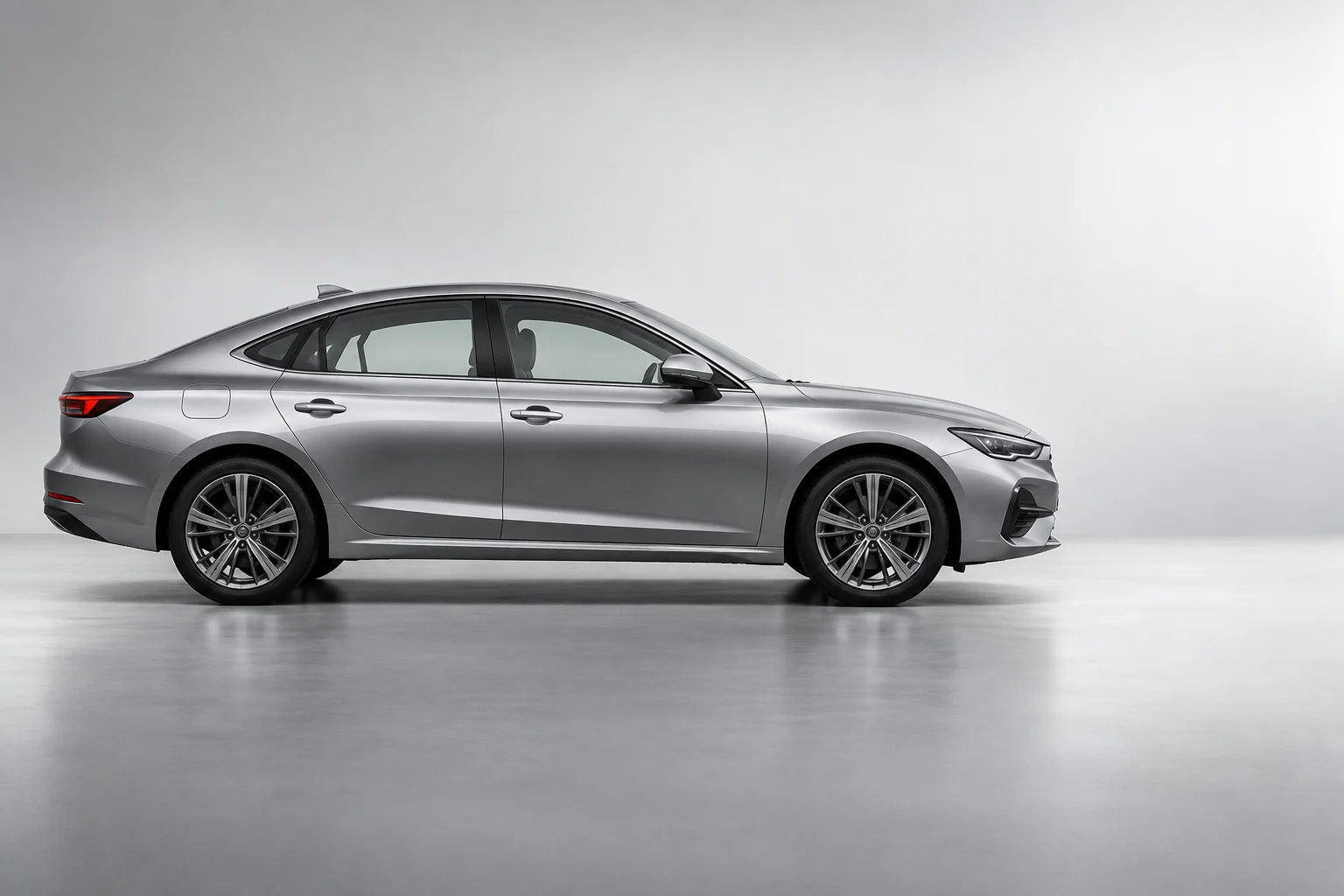
A car's aerodynamic efficiency is determined by the product of its drag coefficient (Cx) and frontal area, not the Cx alone. This factor dictates air resistance, which increases quadratically with speed and accounts for 30-40% of energy consumption in electric vehicles, compared to less than 10% of fuel consumption in thermal cars.
Aerodynamic Drag: More Than Just a Number
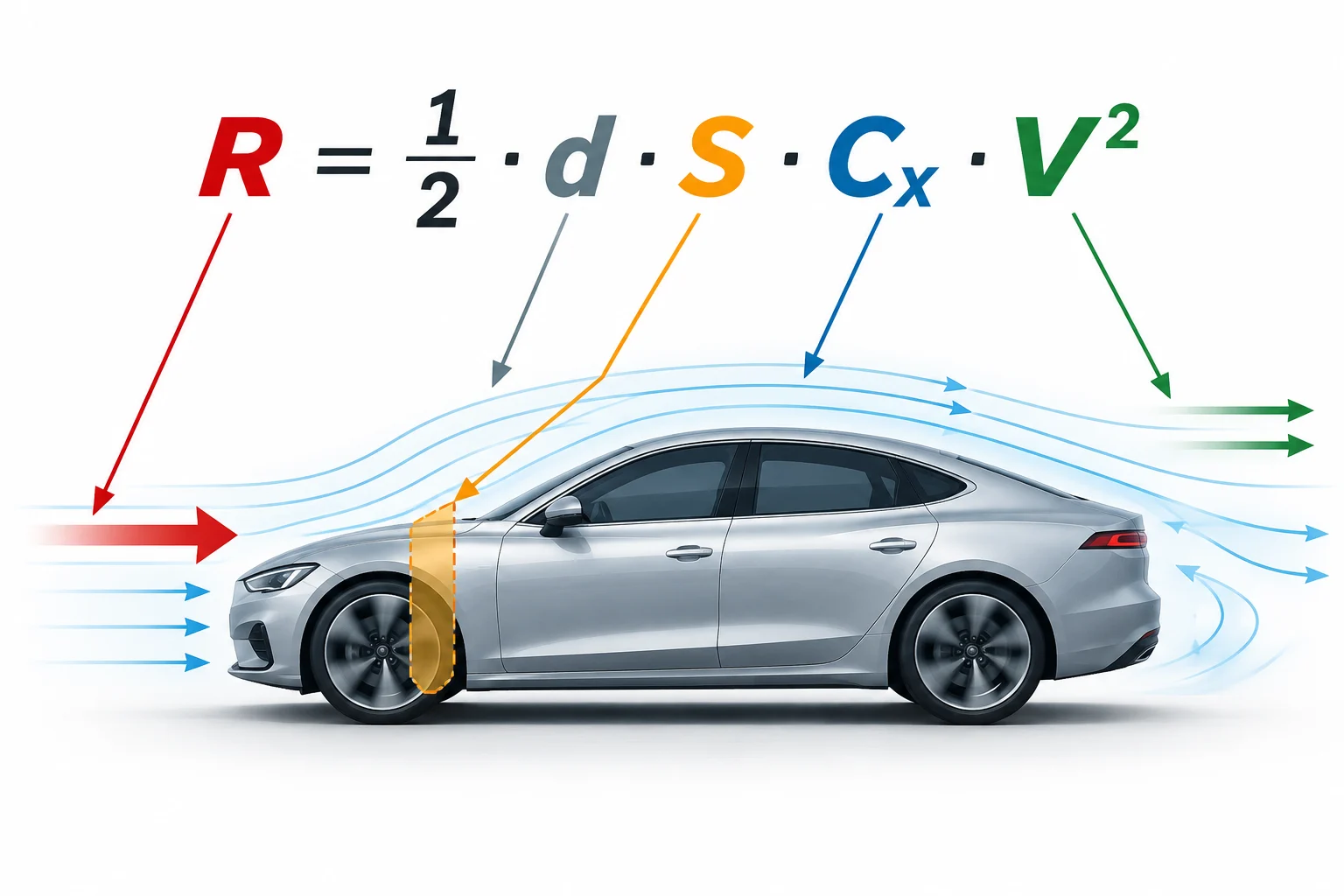
When comparing cars, it is common to look at the aerodynamic drag coefficient (Cx) as an indicator of efficiency. However, this value alone does not determine the total resistance the vehicle offers to the air. The actual aerodynamic drag is calculated using the formula R = ½ d*S*Cx*V², where d is air density, S is the frontal area, Cx is the drag coefficient, and V² is the velocity squared.
This means that a vehicle's aerodynamic drag is determined by the product of its frontal area and its Cx value. A car can have an excellent Cx, but if its frontal area is very large, the total resistance will be greater than that of a vehicle with a slightly worse Cx but a more compact silhouette. Therefore, to evaluate aerodynamic efficiency, both factors must be interpreted together.
Section references: Aerodinámica en la era de la electromovilidad ↗ · Aerodinámica automotriz: principios básicos ↗
- The physical formula is R = ½ d*S*Cx*V².
- Frontal area (S) and Cx are the variables that design can optimize.
- Air density and speed are external or usage-based factors.
Why Speed Amplifies Aerodynamic Impact
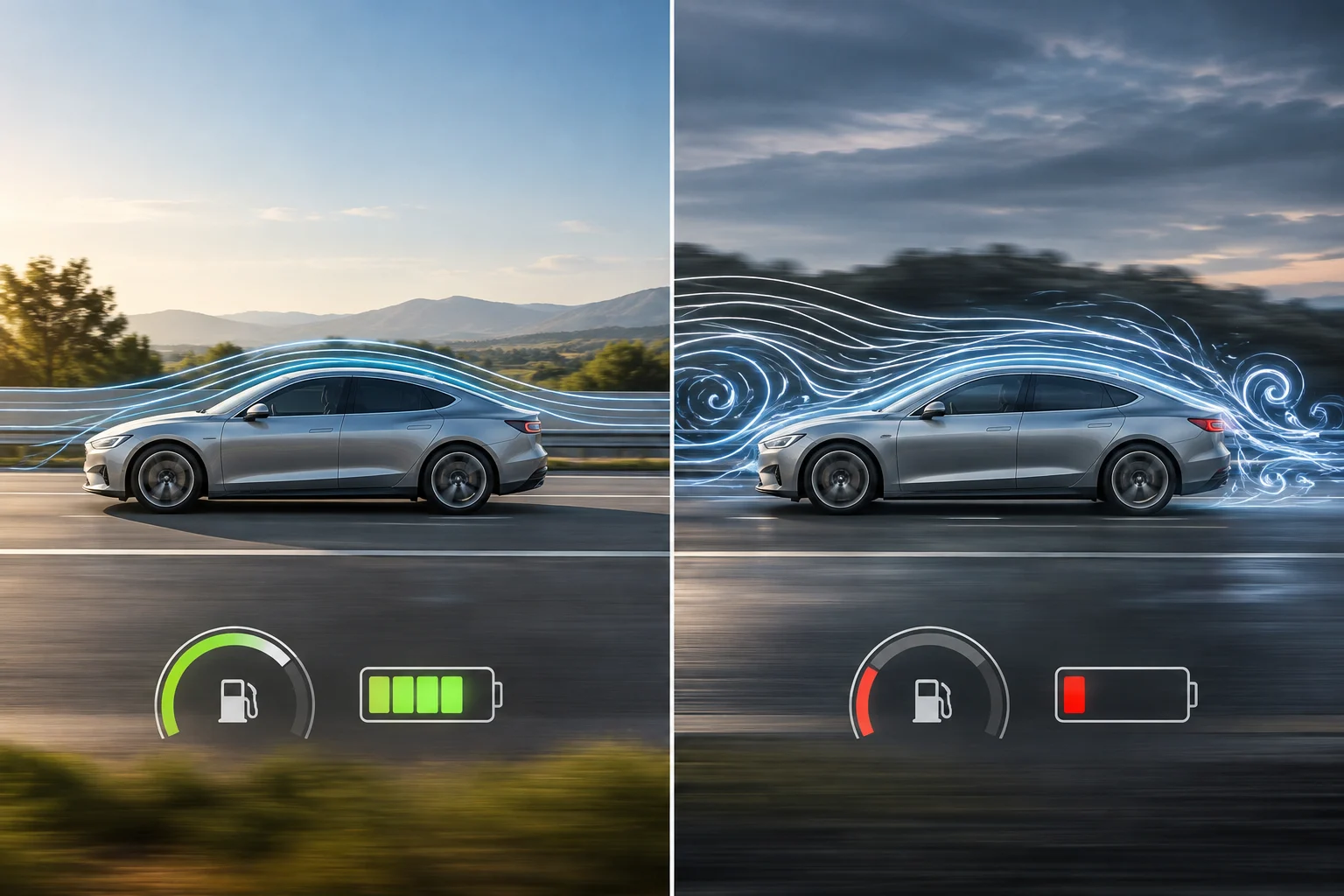
A crucial aspect of aerodynamic physics is that drag increases quadratically with speed. This implies that at low speeds, air resistance is minimal, but as you accelerate, its impact spikes. For example, doubling the speed multiplies the aerodynamic drag by four.
This relationship has direct consequences for energy consumption. In the WLTP driving cycle, aerodynamic drag causes between 30% and 40% of energy consumption in electric cars, compared to less than 10% of fuel consumption in a diesel or petrol vehicle. This difference is due to the fact that thermal engines have other more significant sources of loss at low and medium speeds, whereas in electric vehicles, the efficiency of the drivetrain makes air resistance the dominant factor at cruising speed.
Section references: Aerodinámica en la era de la electromovilidad ↗
- Aerodynamic drag grows with the square of the speed.
- In electric cars, it represents 30-40% of energy consumption in the WLTP cycle.
- In thermal cars, it represents less than 10% of fuel consumption in the WLTP cycle.
Design Factors Influencing Efficiency
Vehicle designers work primarily on the Cx and the frontal area (S) to optimize aerodynamics, as other variables like air density are constants or not directly controllable by design. A tall and wide car offers more aerodynamic resistance than a low and narrow car due to its larger frontal area.
In addition to the general silhouette, details such as the mirrors, wheels, and the vehicle's underbody play an important role in aerodynamic resistance. A car with large mirrors and wide tires will offer more resistance than one with small mirrors and narrow tires. The specific configuration of the vehicle, including body height and underbody design, influences the final efficiency.
Section references: Aerodinámica automotriz: principios básicos ↗ · Aerodinámica y diferencia entre Fx y Cx ↗
- Frontal area (S) depends on the car's height and width.
- Mirrors and wheel design affect aerodynamic resistance.
- The vehicle's underbody and body height influence turbulence.
How to Interpret Published Data
In the automotive industry, the Cx coefficient is usually found between values of 0.25 and 0.40 in most passenger cars, with lower numbers being more efficient. However, it is important not to confuse Cx with homologated consumption. A low Cx does not guarantee lower consumption if the frontal area is large or if the vehicle is heavy.
To compare aerodynamic efficiency more accurately, it is useful to look for the 'aerodynamic drag factor,' which is the product of the Cx by the frontal area. For example, a car with a Cx of 0.22 and a frontal area of 2.33 m² has a factor of 0.513 m². This value allows for a fairer comparison between vehicles of different sizes and shapes.
| Vehicle | Drag Coefficient (Cx) | Frontal Area (m²) | Drag Factor (m²) |
|---|---|---|---|
| Reference Car (e.g., Taycan) | 0.22 | 2.33 | 0.513 |
Section references: Aerodinámica en la era de la electromovilidad ↗ · Todo sobre el coeficiente Cx y su impacto en los coches ↗
- Typical Cx in passenger cars ranges between 0.25 and 0.40.
- The drag factor (Cx * S) is a more complete metric for comparison.
- Homologated consumption depends on many factors besides aerodynamics.
Why doesn't a car with a lower Cx always consume less?
Because total aerodynamic drag depends on the product of the Cx and the frontal area. A car with a low Cx but a very large frontal area can have greater total resistance than a car with a slightly higher Cx but a more compact silhouette.
What is the aerodynamic drag factor?
It is the result of multiplying the drag coefficient (Cx) by the vehicle's frontal area (S). This metric offers a more complete view of aerodynamic efficiency than the Cx alone, as it takes into account the physical size of the car.
How much does aerodynamics influence the consumption of an electric car?
In the WLTP driving cycle, aerodynamic drag causes between 30% and 40% of energy consumption in electric cars. This proportion is significantly higher than in thermal vehicles, where it represents less than 10% of fuel consumption.
How does speed affect consumption due to aerodynamics?
Aerodynamic drag increases quadratically with speed. This means that at cruising speeds, the impact of aerodynamics on consumption is much greater than at low urban speeds.