Brake-by-Wire in Cars: How It Works and What It Is
Brake-by-wire converts the driver’s braking input into an electronic signal that manages braking. Here’s how it differs from ABS and energy recovery, and what to check in the car’s documentation.
Key points
Brake-by-wire replaces part of the direct mechanical or hydraulic link between the pedal and the brakes with sensors, electronics and actuators. It is different from ABS and regenerative braking; the available pedal feel and backup systems depend on the design.
What brake-by-wire means
Brake-by-wire describes a system in which sensors interpret the action on the pedal and transmit it electronically to a control unit, which coordinates the braking actuators. The pedal remains the driver’s input: the name does not mean that the car brakes without human control.
The difference from a conventional system lies in how that command is transmitted. Instead of relying solely on a direct mechanical or hydraulic connection between the pedal and the brakes, the system uses electronic signals. The exact architecture, including any backup components, varies by vehicle; the term alone does not specify how it is designed.
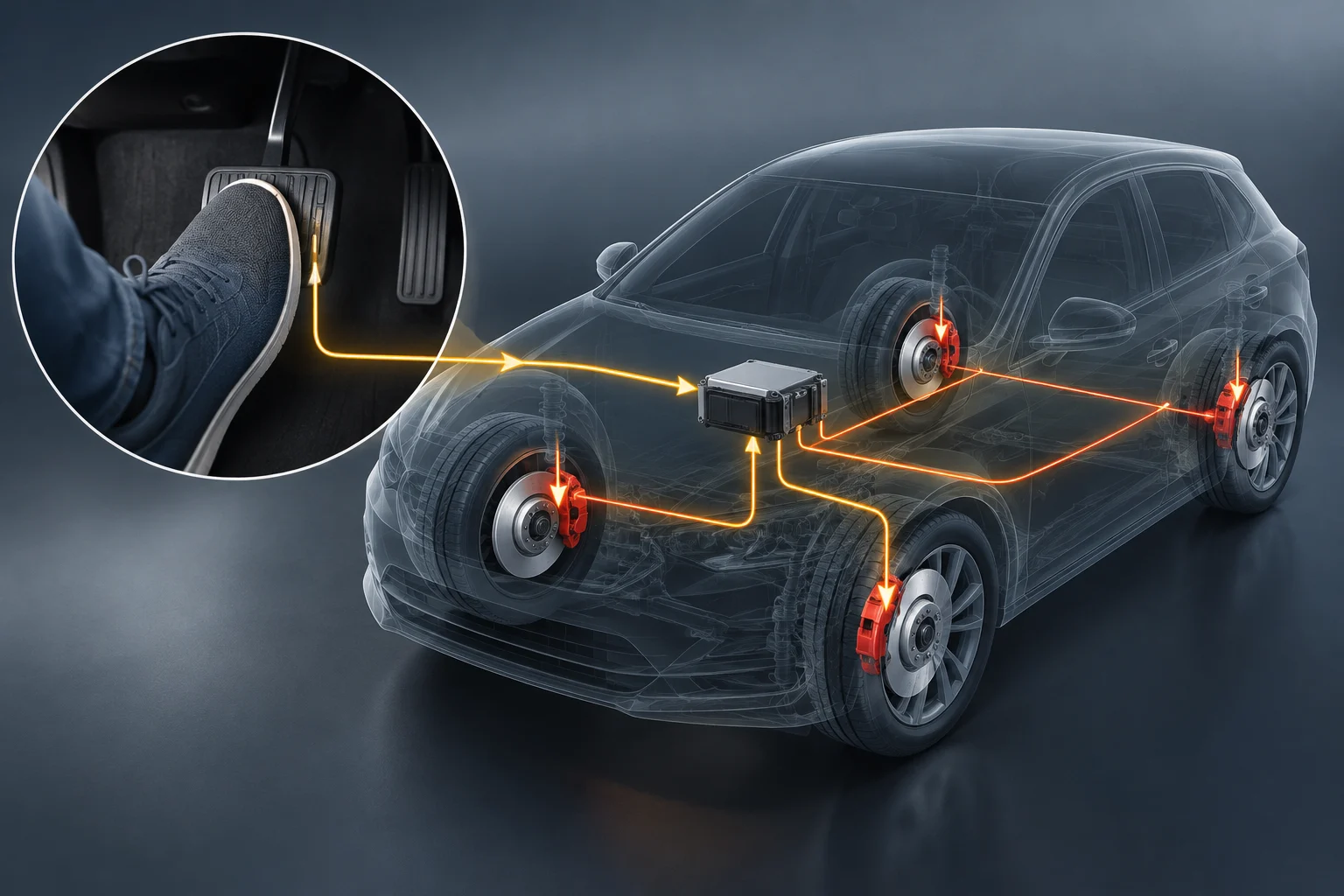
From the pedal to the wheels: how the command travels
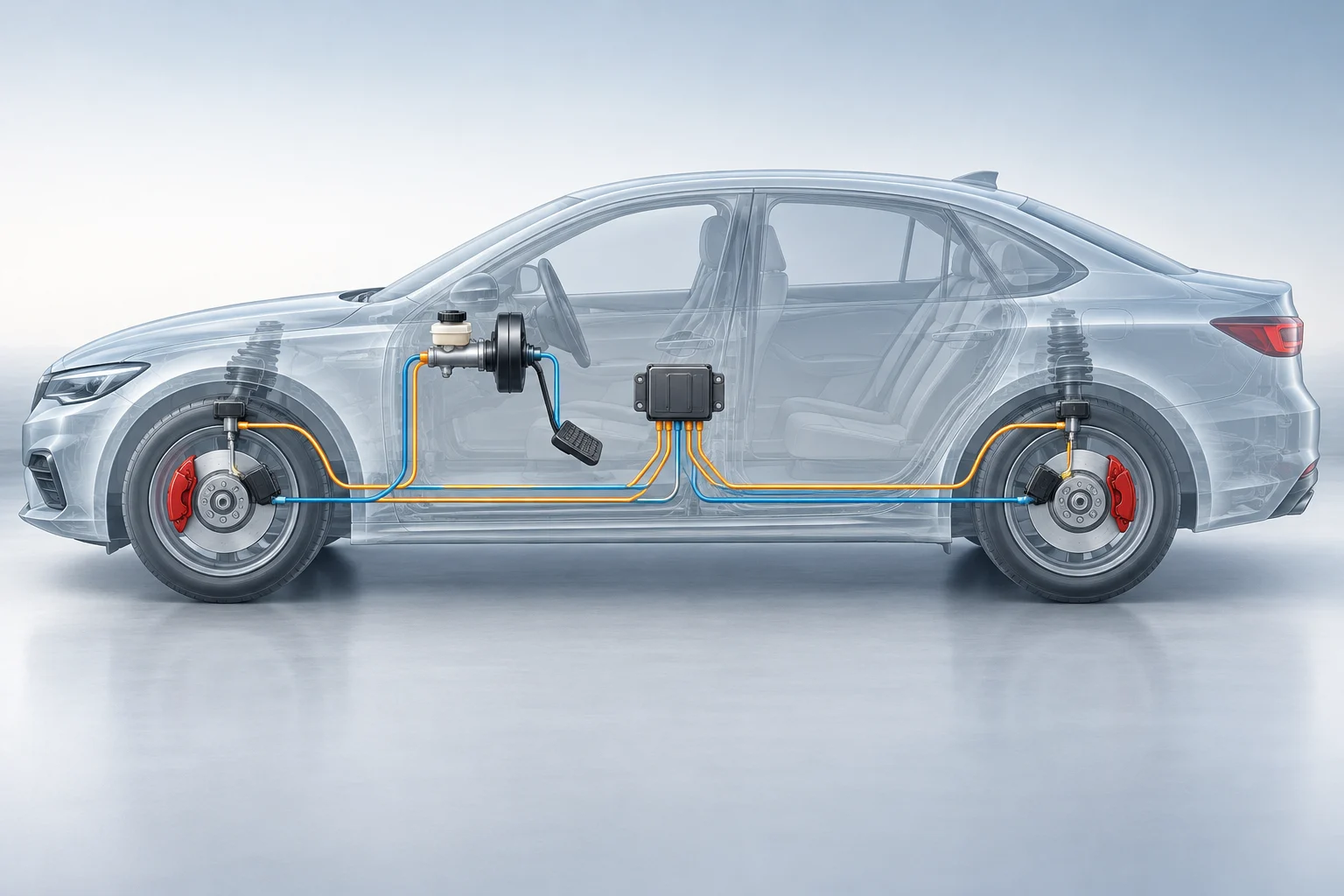
In general, the driver presses the pedal; sensors detect the action and send information to a control unit. The unit processes the signal and manages the actuators that apply the brakes at the wheels. The command still comes from the driver, even though electronics handle its transmission and execution.
This explains the principle, not a universal configuration. Some systems may retain a hydraulic path or a backup function, but their presence and exact operation cannot be inferred from the term “brake-by-wire” alone. Consult the technical documentation for the specific model and version.
- Pedal: receives the driver’s input.
- Sensors and control unit: detect and interpret the command.
- Actuators: apply the brakes at the wheels, according to the vehicle’s design.
- Backup: its type and capabilities depend on the specific system.
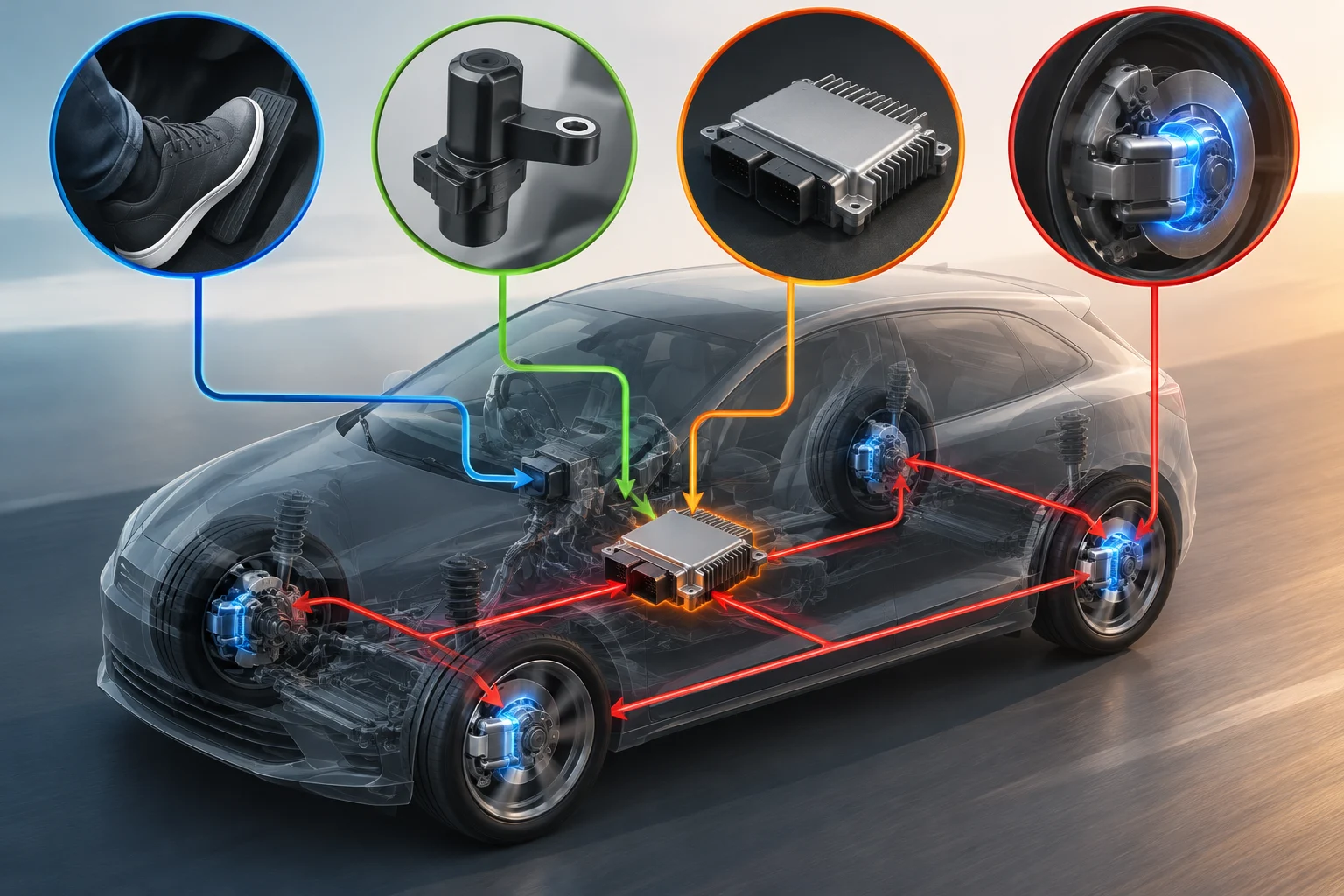
Brake-by-wire, ABS and regenerative braking
These are different concepts and can work together. Brake-by-wire describes how a braking command is transmitted and managed. ABS controls brake pressure to prevent the wheels from locking during emergency braking and help the driver maintain control. As RACE explains, the ABS system it describes uses wheel-speed sensors and a control unit that regulates valves to adjust brake-fluid pressure.
Regenerative braking, by contrast, uses the electric motor to recover energy while slowing down. It does not define how the pedal command is transmitted, nor does it replace the ABS function by itself. A car can combine regenerative braking, service brakes and anti-lock systems.
| System or function | What it does | What it does not mean by itself |
|---|---|---|
| Brake-by-wire | Transmits and manages the braking command electronically. | Does not specify each model’s backup system. |
| ABS | Modulates pressure to prevent the wheels from locking during emergency braking. | Does not describe how the pedal command is initially transmitted. |
| Regenerative braking | Recovers energy during deceleration through the electric system. | Is not the same as ABS and does not define the connection between the pedal and brakes. |
Section references: ¿Qué es el ABS de un coche y para qué sirve? ↗
Redundancy and response to a failure
What happens if an electronic braking system fails depends on its specific architecture, including which redundant circuits or components it has and which functions remain available. It is not accurate to assume that every car described as using brake-by-wire responds in the same way or retains the same hydraulic backup braking.
To find out how a particular car responds, consult the owner’s manual and technical documentation for the exact version. If a brake warning appears or the vehicle’s behavior changes, follow the manufacturer’s instructions and seek assistance. Do not attempt to diagnose or repair braking components based on a general description.
What to check before choosing a car
A sales brochure may use “brake-by-wire” as a general term, but that alone does not tell you how the complete system works. When comparing cars, look for a technical description of the braking architecture, whether it has a hydraulic or other backup path, and which functions remain available if a failure occurs. If this information is not provided, ask the manufacturer or dealer for documentation covering the exact model and version.
It is also useful to check each function separately: find out which ABS system the car has and whether it offers regenerative braking. This helps avoid treating a marketing term as a guarantee of a particular response or as a synonym for other technologies.
- Identify the make, model, year and version; the design can vary between variants.
- Check the owner’s manual and technical documentation for the type of backup system and how it works.
- Distinguish electronic brake management from ABS and energy recovery.
- Do not infer how the system responds to a failure from the marketing name alone.
Does brake-by-wire mean the car brakes itself?
No. It describes electronic transmission of the braking command; the driver initiates braking by pressing the pedal.
Does brake-by-wire replace ABS?
Not necessarily. Brake-by-wire describes how the command is transmitted; ABS prevents the wheels from locking by modulating pressure. The two functions can coexist.
Do all cars with brake-by-wire retain a hydraulic backup circuit?
That cannot be said of every car. The backup system depends on the vehicle’s architecture and should be checked in the documentation for the specific model and version.
Is regenerative braking the same as brake-by-wire?
No. Regenerative braking recovers energy during deceleration; brake-by-wire describes the electronic management of the braking command.