Types of Automatic Car Transmissions: Torque Converter, Dual-Clutch, and CVT
Discover how torque converter, dual-clutch, and CVT automatic transmissions work. Compare their driving behavior, maintenance requirements, and feel to choose the best option for your needs.
Key points
Modern automatic transmissions mainly use torque converters, dual-clutch systems, or CVTs. Each architecture transmits engine power differently, affecting smoothness, response, and maintenance needs. The best choice depends on intended use and parts availability for the specific model.
What the transmission does in an automatic car
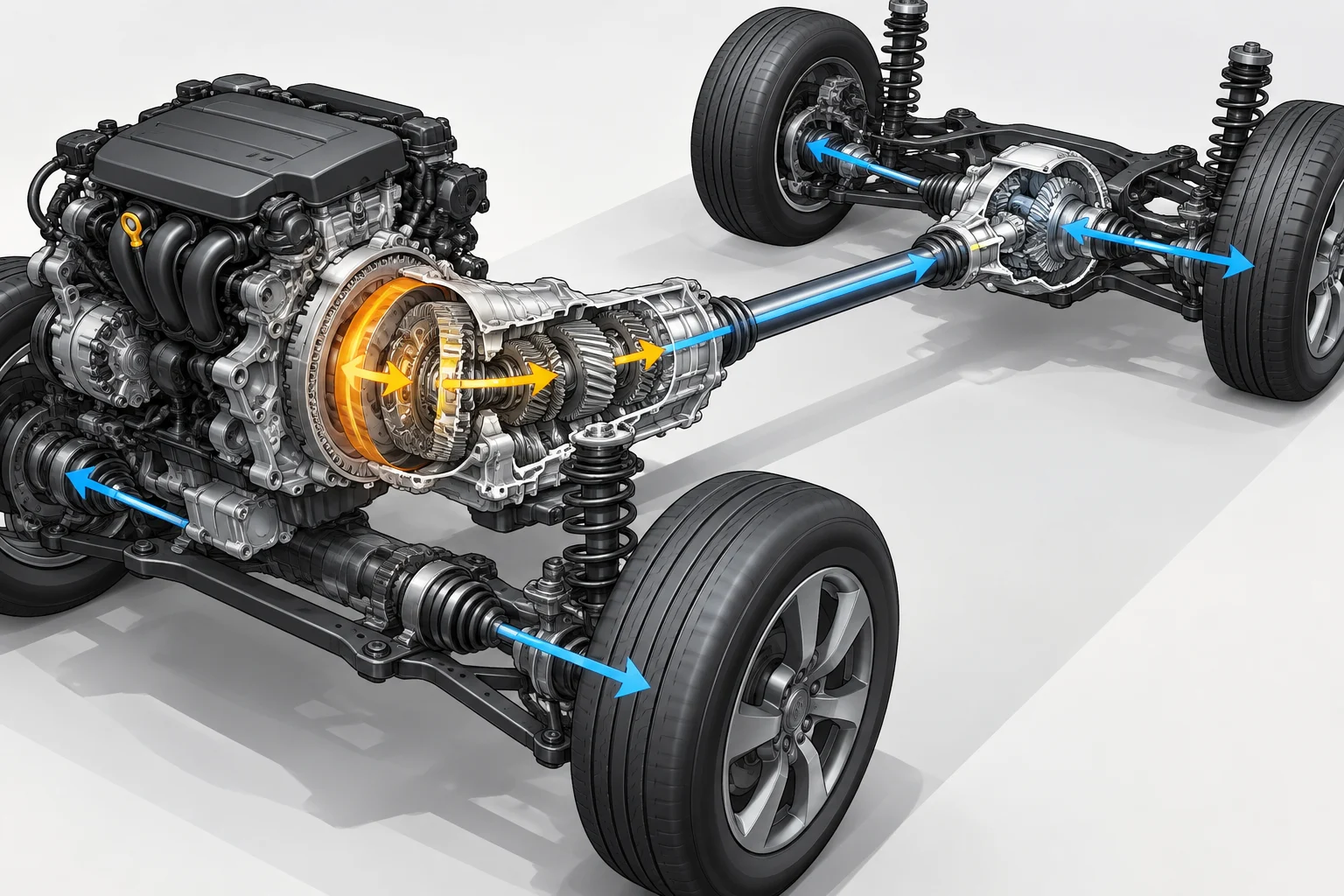
In a vehicle with an automatic transmission, the gearbox adapts the engine's power to the wheels without the driver operating a clutch or shifting gears manually. Unlike a manual gearbox, where the driver decides when and how to shift, an automatic uses an electronic control unit to manage this process based on speed, engine load, and pedal inputs.
There are several architectures to achieve this. The main ones are the torque converter, the dual-clutch transmission, and the continuously variable transmission (CVT). Each uses a different physical mechanism to transmit torque, resulting in distinct driving sensations and specific maintenance requirements.
Torque converter: the traditional automatic
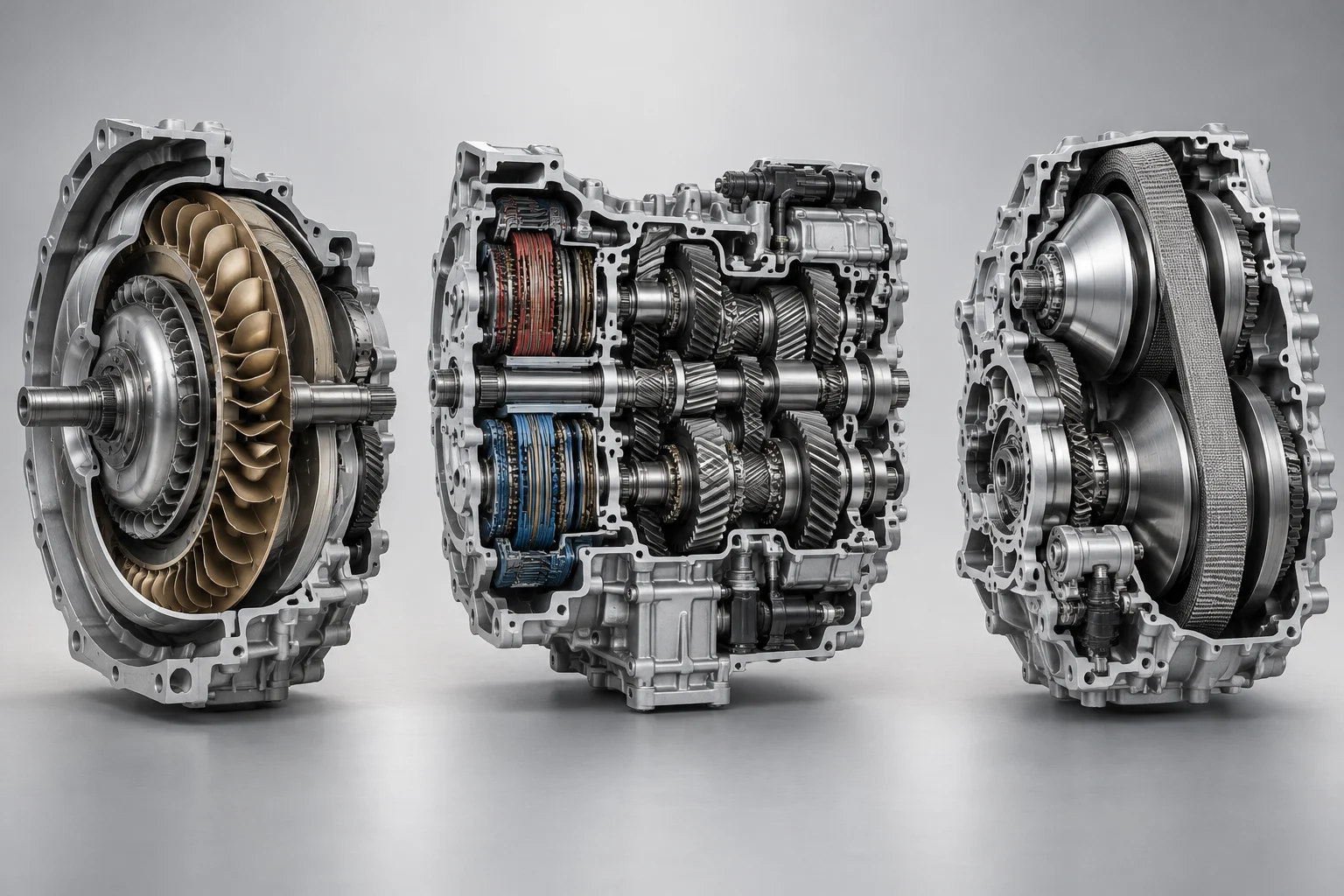
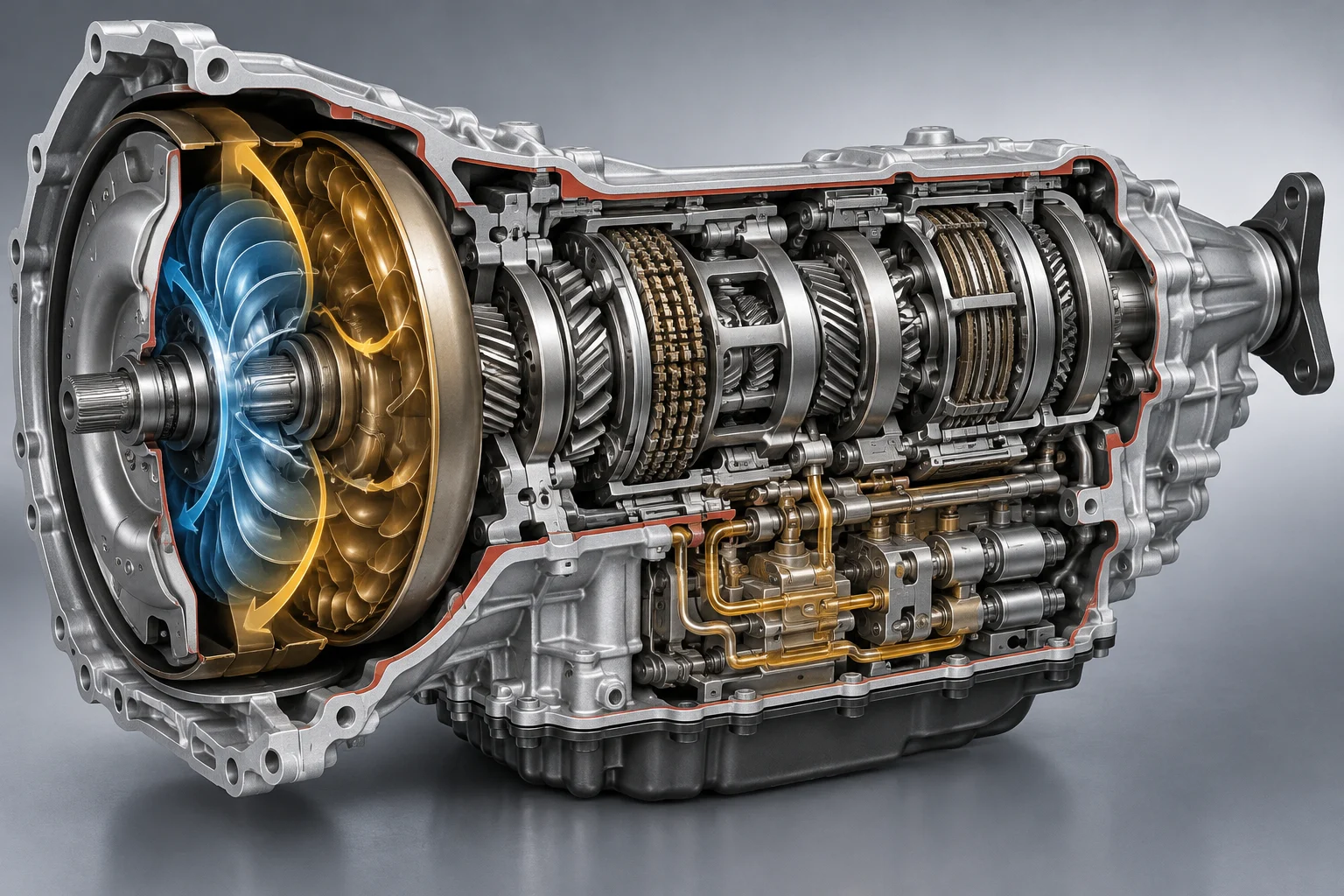
The torque converter is the oldest and most widespread technology. It works via a hydraulic coupling that transmits engine torque to a gear set, usually planetary. Its major advantage is that it does not use a mechanical friction clutch that wears out, which often translates to greater durability and smoothness during stops and starts.
When driving, the response is very smooth, ideal for urban traffic. However, as a hydraulic system, it may have a slight efficiency loss in power transmission compared to direct mechanical systems, although differences in fuel consumption are becoming smaller with modern technologies.
Section references: Qué cambio automático de segunda mano da menos problemas: DSG, CVT o convertidor ↗
- Hydraulic transmission without a friction clutch.
- Very smooth in maneuvers and starts.
- Generally requires less maintenance than a dual-clutch.
Dual-clutch: fast and efficient shifts
The dual-clutch transmission (known as DSG in Volkswagen or DCT in general) consists of two independent clutches: one manages even gears and the other odd gears. This allows the next gear to be always pre-engaged, enabling extremely fast shifts without loss of torque.
Since no slipping occurs during power transmission, this system improves efficiency and can reduce fuel consumption. The feeling when accelerating is more direct and sporty. However, its reliability depends heavily on maintenance, especially oil changes and the inspection of the mechatronic unit, which is the electronic component that manages the clutches.
Section references: Qué cambio automático de segunda mano da menos problemas: DSG, CVT o convertidor ↗ · ¿Qué diferencias hay entre un cambio automático de doble embrague y uno de variador continuo? ↗
- Two clutches for even and odd gears.
- Very fast shifts without power loss.
- Reliability dependent on oil and mechatronic maintenance.
Continuously Variable Transmission (CVT): variable ratio
The CVT does not have defined gears. It uses two variable-diameter pulleys connected by a metal belt (or in some cases, a chain) to vary the transmission ratio continuously. This allows the engine to operate always at its most efficient RPM.
When accelerating, the engine quickly revs up to an optimal point while the pulleys adapt the ratio. This can generate a high-pitched sound, similar to clutch slipping, which some drivers find annoying. Additionally, CVTs have greater limitations in transmitting high torque, making them more common in mid-to-low-range cars and hybrids.
It is important to distinguish the conventional CVT from hybrid systems (such as Toyota's e-CVT), which do not use pulleys or a belt, but rather an epicyclic gear train to distribute torque between the thermal engine and the electric motors.
Section references: Qué cambio automático de segunda mano da menos problemas: DSG, CVT o convertidor ↗ · ¿Qué diferencias hay entre un cambio automático de doble embrague y uno de variador continuo? ↗
- No fixed gears: continuous transmission ratio.
- Engine always in efficient RPM range.
- Limited in transmitting high torque.
- Hybrids use epicyclic gear trains, not pulleys.
Automated manual: the automation of the manual
Robotized or automated transmissions are, in essence, manual gearboxes with electronic actuators that manage the clutch and gear shifts. They are not a distinct transmission architecture, but an automation of the manual gearbox.
They are distinguished from other types because they maintain the gear and clutch structure of a manual gearbox. Their behavior may be less smooth than a torque converter or dual-clutch, as they depend on the actuation speed of the electric servos.
Section references: Tipos de cambios automáticos: guía fácil para elegir el mejor ↗
- Manual gearbox base with electronic actuators.
- Automatic management of clutch and gears.
Factors to consider based on the model
There is no 'superior' automatic transmission type in absolute terms. The choice depends on the control unit programming, the maintenance performed, and the intended use. A well-maintained dual-clutch can be very reliable, while a neglected one may present costly problems in the mechatronics or clutches.
The torque converter is usually the most robust option for intensive use or in the used car market, due to its lower wear complexity. The CVT is efficient but requires attention to the belt and fluid in some models. When buying a used car, it is crucial to verify the specific maintenance history of the transmission.
| Characteristic | Torque Converter | Dual-Clutch | CVT |
|---|---|---|---|
| Main Mechanism | Hydraulic coupling | Two mechanical clutches | Pulleys and metal belt |
| Smoothness at Start | Very High | High | High |
| Shift Speed | Medium | Very High | Continuous (no discrete shifts) |
| Torque Transmission | High | Very High | Limited |
| Critical Maintenance | Low | High (oil and mechatronics) | Medium (fluid and belt) |
Section references: Qué cambio automático de segunda mano da menos problemas: DSG, CVT o convertidor ↗
- Oil maintenance is critical in dual-clutch and CVT.
- Torque converter usually has lower repair costs in case of failure.
- Control unit programming influences smoothness and consumption.
How to verify the transmission type
To know what type of automatic transmission a specific car has, the most reliable method is to consult the manufacturer's official documentation or the homologation certificate. In the vehicle's technical sheet, the transmission code or a description such as '6-speed automatic', 'DSG', 'CVT', or 'torque converter' usually appears.
In the used car market, it is important to ask the seller about the gearbox maintenance history, especially if it is a dual-clutch or CVT. A history of regular oil changes is a good indicator of the transmission's health.
Section references: Tipos de cambios automáticos: guía fácil para elegir el mejor ↗
- Consult the technical sheet or homologation certificate.
- Ask about the transmission oil maintenance history.
- Review the manufacturer's service manuals to know the intervals.
Which automatic transmission is most reliable for a used car?
The torque converter is usually considered the most robust and low-maintenance option in the used car market, due to the absence of friction clutches. However, the reliability of a dual-clutch or CVT depends heavily on the maintenance history, especially oil changes.
Why does a CVT make a 'slipping' noise when accelerating?
In a CVT, when accelerating, the engine quickly revs up to an optimal RPM while the pulleys adapt the ratio. This increase in RPM without a discrete gear shift can generate a high-pitched sound that is perceived as if the clutch were slipping, although it is the normal operation of the system.
Does a dual-clutch consume less than a torque converter?
Yes, generally. Since no slipping occurs during power transmission, the dual-clutch is more efficient in power transfer, which can translate to lower fuel consumption compared to a torque converter, especially in dynamic driving.
Do Toyota hybrids use a traditional CVT?
No. Although it is colloquially called a CVT, the transmission system in Toyota hybrids (e-CVT) does not use pulleys or a metal belt. It is an epicyclic gear train that distributes torque between the thermal engine and the electric motors continuously.