Motorcycle Power and Weight: How to Read the Technical Sheet
The technical sheet allows you to verify power, mass, and power-to-weight ratio. Learn what its codes mean and which differences you should check before buying.
Key points
To compare motorcycles, check the technical sheet for power (P.2), curb weight (G), and the power-to-weight ratio (Q). Verify how the weight was measured, as dry weight and curb weight figures are not directly comparable.
What data to look for in the technical sheet
Before buying a new or used motorcycle, locate three fields on the ITV card or technical sheet: P.2, engine power; G, curb weight; and Q, power-to-weight ratio. These are documented references that help compare vehicles, but they do not by themselves describe how the motorcycle will feel on the road.
The technical sheet identifies the vehicle and gathers data such as make, model, displacement, power, and weight. If you are comparing a second-hand offer, verify that the document corresponds to the specific unit—for example, by its license plate or chassis number—and that it matches the advertised details.
Section references: Ficha técnica moto: ¿qué es y qué información tiene? ↗ · Apéndice II: Ficha Técnica (Datos de la tarjeta ITV) ↗
- P.2: Engine power.
- G: Curb weight.
- Q: Power-to-weight ratio.

Weight depends on how it is measured
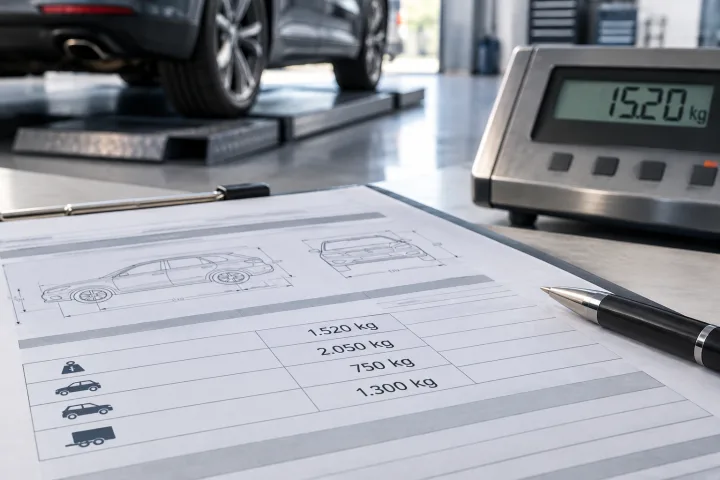
Curb weight (G) should not be confused with the dry weight that some brands publish in their catalogs. Depending on the convention used, the curb weight figure may include fuel and fluids; dry weight excludes them and may leave out other elements. Therefore, two numbers expressed in kilograms are not necessarily comparable.
Check that the motorcycles you are considering use the same criterion and consult the manufacturer's definition for each model. The maximum authorized mass (MAM) is a distinct concept: it does not equal the curb weight. To interpret its specific data, review the corresponding field in the vehicle documentation.
Section references: Ficha técnica moto: ¿qué es y qué información tiene? ↗ · Cómo interpretar la ficha técnica de una moto ↗
- Do not directly compare a dry weight figure with a curb weight figure.
- Review what elements the measurement includes, especially fuel and fluids.
- Distinguish the motorcycle's mass from the maximum authorized mass.

Power-to-weight ratio: useful, but not definitive
The power-to-weight ratio summarizes how much power corresponds to a given mass. As a guideline, if two motorcycles have the same power and one weighs less under the same measurement criterion, the lighter one will have a more favorable ratio. The Q field allows you to consult the declared value; you can also calculate an approximate ratio by dividing power by mass, always using consistent units.
This indicator serves to order comparisons, not to predict acceleration or behavior on its own. Other aspects of the engine, transmission, and intended use also matter. Moreover, maximum power is declared for a specific engine speed: maximum torque may appear at a different speed, and the power figure does not tell the whole story of how the engine delivers force.
Section references: Ficha técnica moto: ¿qué es y qué información tiene? ↗ · Cómo interpretar la ficha técnica de una moto ↗
- Compare figures calculated with the same power unit and the same weight criterion.
- Interpret Q as a comparison indicator, not as a complete measure of behavior.
- Do not confuse maximum power with engine torque, nor assume both occur at the same engine speed.
How to compare motorcycles before deciding
To compare two options, note P.2, G, and Q from their technical sheets and verify that both mass figures were obtained with equivalent criteria. If power appears in different units, convert them before calculating or comparing; you can use the tool to convert kW and HP.
If your priority is to check compatibility with a driving license, do not rely solely on the power-to-weight ratio or displacement: verify the declared power and the requirements applicable to your license in current regulations. The technical sheet provides vehicle data; the legal check must be based on the license category and specific conditions.
Section references: Ficha técnica moto: ¿qué es y qué información tiene? ↗ · Apéndice II: Ficha Técnica (Datos de la tarjeta ITV) ↗
- Confirm that the documentation corresponds to the version and unit you want to buy.
- Compare power and mass with equivalent units and measurement criteria.
- If a figure in the advertisement differs from the technical sheet, request clarification before closing the purchase.
Where does motorcycle power appear in the technical sheet?
In field P.2, identified as engine power.
Can I compare dry weight with curb weight?
Not directly. Dry weight excludes fuel and fluids, while curb weight may include them. Check what elements each figure covers.
Does the power-to-weight ratio determine how a motorcycle accelerates?
It is a useful indicator for comparison, but it is not enough to predict behavior. Maximum power is measured at a specific engine speed and does not by itself reflect torque delivery or other vehicle factors.