Scooter Luggage: Under-Seat Storage or a Top Box?
A helmet, rain gear and everyday items may not fit just because the advertised capacity suggests they should. Learn how to compare your scooter’s under-seat storage with a top box and what to check before fitting one.
Key points
Choose scooter luggage by measuring what you carry and checking the shape of the under-seat compartment: the advertised volume does not guarantee a helmet will fit. If you need more room, consider a top box only after confirming that its mounting system fits your scooter and checking the load limits.
Start with what you carry every day
Your choice depends less on a stated litre capacity than on the specific items you need to transport. Make a list—helmet, rain gear, gloves, lock and other belongings—and measure the rigid items, especially the helmet. Then check whether they fit in the available space and whether the seat closes without force.
Your routine matters too. Storing one helmet for short trips is different from regularly needing extra space. Consider whether you usually ride alone or with a passenger, and whether you need to access your belongings several times a day.
Section references: Cómo escoger un baúl para tu moto ↗
- List what you usually carry and what needs to be locked away or protected from rain.
- Measure your helmet and bulky items, taking their shape into account as well as their maximum dimensions.
- Consider how often you use the luggage and whether it needs to stay on the scooter.
Under-seat storage: litres do not guarantee a helmet will fit
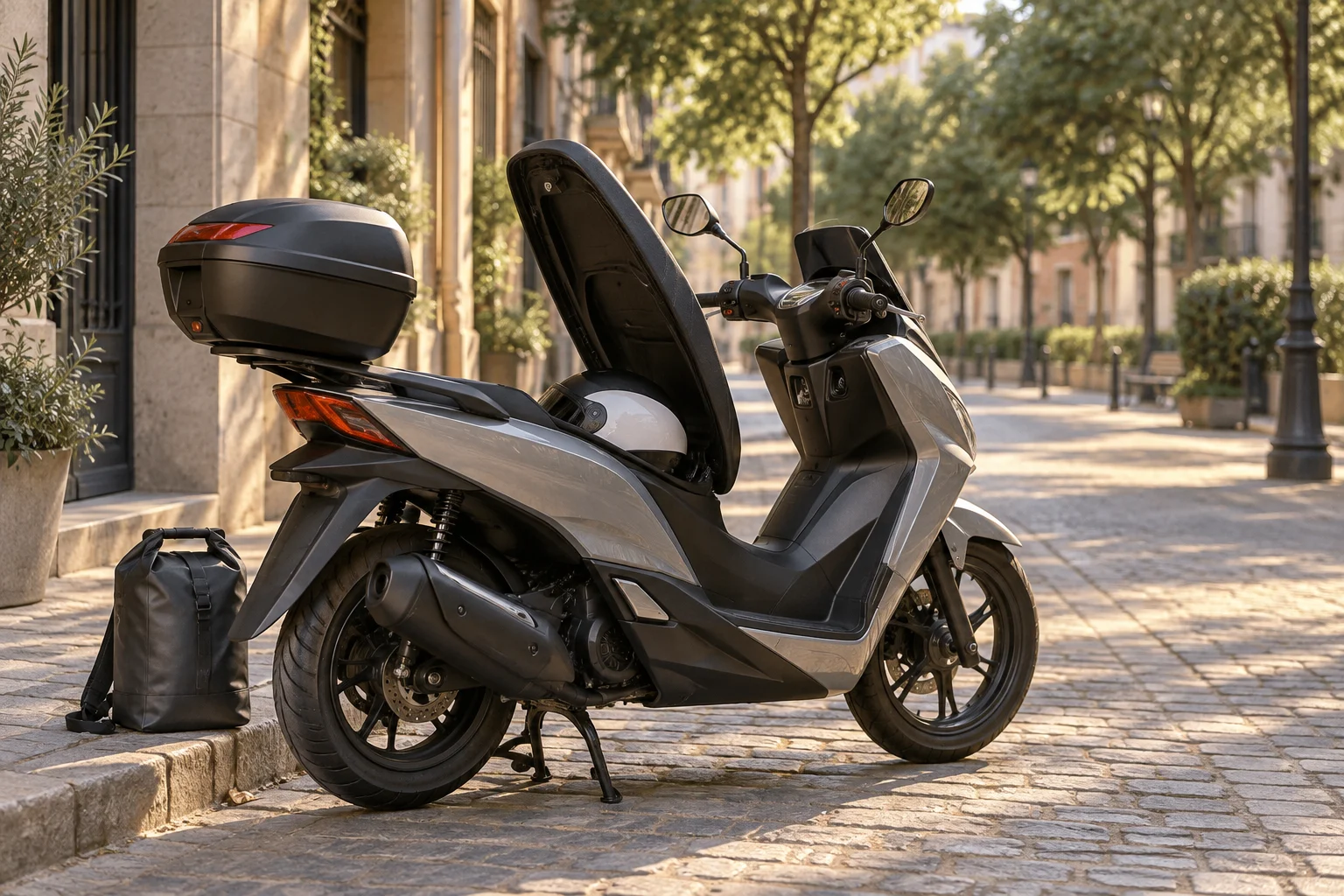
The stated capacity is a useful guide, but it does not tell you the shape of the available space. A compartment may have enough volume on paper yet still be too narrow, short or awkwardly shaped for a particular helmet. The practical test is to try the helmet and close the seat normally, without pressing down or interfering with the latch.
Whether you are buying a scooter or already own one, consult the manual and check the compartment itself. If the manufacturer specifies which type or size of helmet fits, use that as a guide; do not assume that every full-face or open-face helmet will fit in the same way.
- If possible, test the compartment with your own helmet.
- Check the shape of the cavity, narrow areas and the space taken up by other components.
- Do not force the seat or latch to fit an item.

When to consider a top box or an auxiliary bag
A rear top box may be an option if the under-seat compartment does not meet your regular needs or you want to carry more than one bulky item. As a general guide for motorcycle top boxes, around 23 litres is often cited for an open-face helmet, about 35 litres for a full-face helmet and jacket, and 45–46 litres for two full-face helmets. These figures do not guarantee that specific items will fit or that a top box is compatible with every scooter: check the dimensions and interior shape of the model you are considering.
An auxiliary bag may work for carrying items if it is compatible with the scooter and its fastening system. The practical choice depends on how much luggage you carry, how often you transport it, and whether you prefer to leave an accessory fitted or remove it. Always check the intended use and the manufacturer’s instructions.
| Approximate capacity | Luggage guide |
|---|---|
| 23 litres | One open-face helmet |
| About 35 litres | One full-face helmet and a jacket |
| 45–46 litres | Two full-face helmets |
Section references: Cómo escoger un baúl para tu moto ↗
- Under-seat storage: built into the scooter and suitable for items that actually fit its shape.
- Top box: can add space, but requires a mounting system compatible with the scooter.
- Auxiliary bag: check how it attaches, how it is removed and whether it is intended for use with your scooter.
Before fitting a top box, check the mount and load limits
First, check whether the scooter has a luggage rack or carrier and whether it is compatible with the top-box base. If it does not, some manufacturers offer model-specific mounts and fittings, which must match the vehicle’s model and version. A rack that appears to fit is not enough.
Consult the scooter’s and accessory’s fitting instructions, as well as the load limits that apply to the vehicle and mount. Do not exceed the stated capacity or assume that the top box’s own weight limit replaces the scooter’s limits. Compatibility and permitted loads depend on the scooter and its documentation; if the documentation is unclear, ask the manufacturer or an authorised dealer to confirm.
Section references: Cómo escoger un baúl para tu moto ↗
- Identify the scooter’s exact make, model and version before looking for a mount.
- Confirm that the rack, base and fittings are compatible with one another and with your scooter.
- Check the load limits and the scooter’s and accessory’s instructions before fitting or loading the box.
A practical choice for everyday use
If you usually carry only a few items and they genuinely fit under the seat, the built-in compartment may save you from adding an accessory. If you regularly need more space, compare top boxes compatible with your scooter, considering their interior shape, capacity and mounting system. For occasional needs, a bag may be enough if its fastening system is intended for your scooter.
Whichever option you choose, make the decision using the items you actually carry and the vehicle documentation. Capacity in litres helps narrow down the options; fit, compatibility and load limits determine whether an option works for your scooter.
Does a 35-litre top box guarantee that any full-face helmet will fit?
No. Litres indicate volume, but fit depends on the helmet’s shape and dimensions and the inside of the top box. Check the measurements and, if possible, try the specific helmet.
Can I fit any top box to my scooter?
Do not assume so. Check that the rack or mount is compatible with your scooter’s make, model and version, and follow the fitting instructions.
Which documents should I check before adding luggage?
Read the scooter’s manual and the instructions for the top box, base and mount. Also confirm the load limits that apply to the vehicle and mounting system.