Touring Motorcycle Range: How to Estimate It
A touring motorcycle’s advertised or calculated range is not guaranteed. Learn to estimate how far you can ride using real-world fuel economy, luggage and a margin for refuelling before the tank runs low.
Key points
Estimate a touring motorcycle’s range by multiplying usable fuel by real-world fuel economy on a representative route. Compare several of your own measurements and plan refuelling stops with a safety margin rather than running the tank low.
Range Is an Estimate, Not a Fixed Figure
To estimate how far you can ride a touring motorcycle, multiply the usable fuel by the kilometres per litre you achieve on a route similar to the one you plan to take. The result is a guide, not a guaranteed distance, and should not be treated as permission to run the tank low.
The tank’s nominal capacity is not necessarily the amount of fuel you should plan to use. Leave a prudent margin when deciding where to refuel, and follow your motorcycle’s manual. Your estimate will be more useful if it reflects your usual route, riding pace and load.
Section references: Autonomía de una moto. ¿Cuánto gastarás en realidad al mes según tu ruta real? ↗
Calculate Range Using Your Own Measurements
The basic formula is: usable fuel in litres × kilometres per litre on the type of route you expect to ride = approximate range. If fuel consumption is given in litres per 100 kilometres, divide 100 by that figure to convert it to kilometres per litre.
To measure your motorcycle’s fuel consumption, fill the tank, note the odometer reading and ride a representative route. When you refuel, try to fill it to the same level and record the litres added. Divide the distance travelled by the litres added. Repeating the measurement over several fill-ups gives you an average that depends less on a single trip. Don’t estimate consumption from the fuel gauge bars or needle alone.
| Measurement | How to obtain it | What it tells you |
|---|---|---|
| Usable fuel | Use the tank capacity as a reference, then account for the margin you want to keep in reserve, following the manual. | Helps avoid treating the entire nominal tank capacity as fuel available for the leg. |
| Fuel economy in km/L | Divide kilometres travelled by litres added; repeat the measurement. | Shows the observed fuel economy on a particular route. |
| Approximate range | Multiply usable fuel by km/L. | Helps guide your stops, but is not a guarantee. |
Section references: Autonomía de una moto. ¿Cuánto gastarás en realidad al mes según tu ruta real? ↗
- Record the odometer reading and litres added at each fill-up.
- Compare similar journeys: an urban trip may not represent a motorway leg.
- Use the average as a guide and leave a margin before planning your next stop.
Adjust for the Route and Load
Measured fuel consumption can change with speed, traffic and how often you accelerate. A passenger and luggage also make a difference: a measurement taken on a lightly loaded motorcycle may not reflect a touring bike carrying its travel load. Use measurements from journeys and conditions similar to those you expect on your trip.
Low tyre pressure is another factor that can increase fuel consumption. Before setting off, check the pressure recommended for your motorcycle and load in the manual. There is no universal percentage for adjusting every motorcycle’s range; the effect depends on the model and how it is used.
Section references: Autonomía de una moto. ¿Cuánto gastarás en realidad al mes según tu ruta real? ↗
Plan Refuelling Stops Without Running the Tank Low
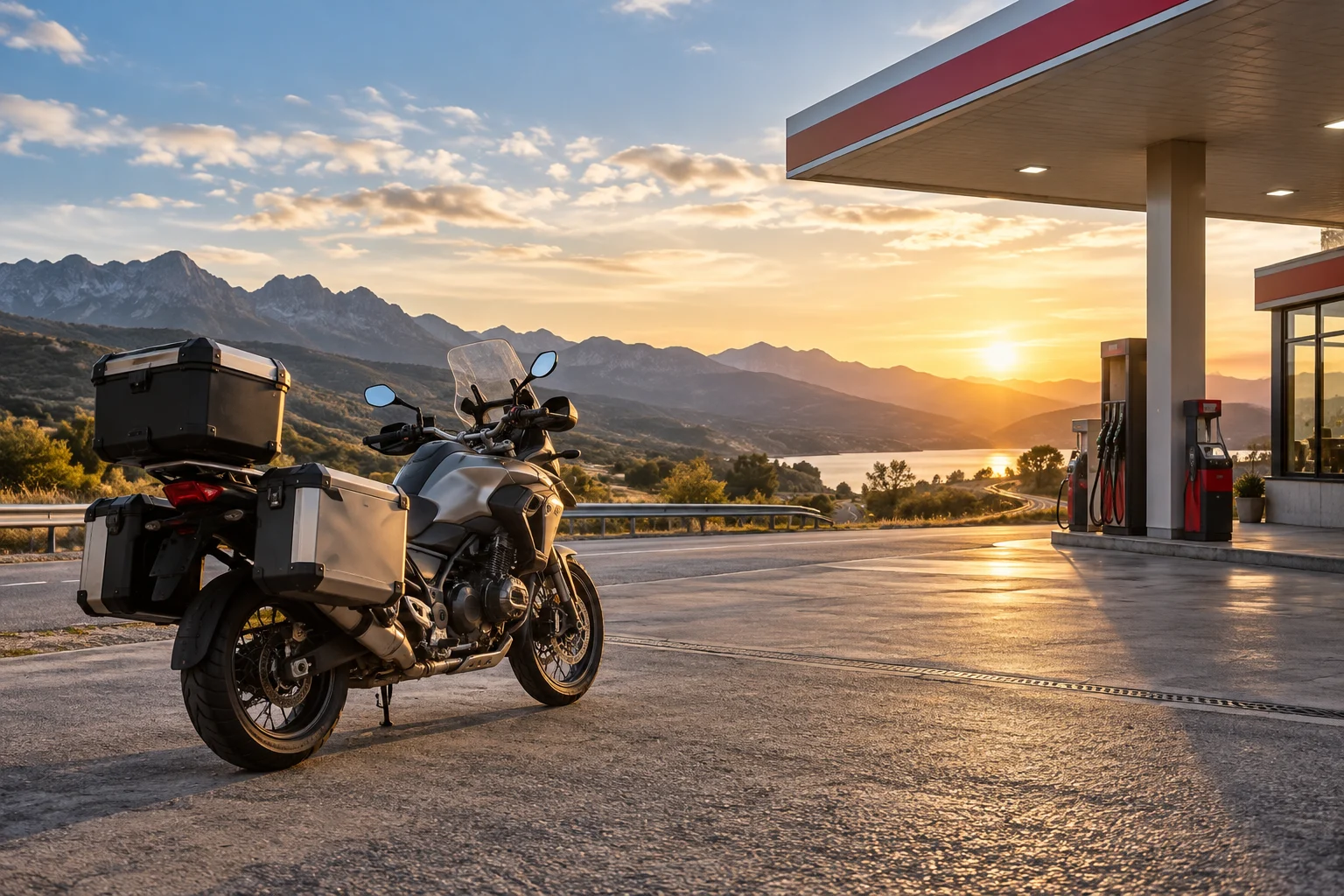
Use your estimated range to identify refuelling options in advance, but don’t treat it as a distance you need to use up. Check which stations are available along your route and plan an alternative in case a stop is unavailable. If your route, pace or load changes, revise the estimate rather than relying blindly on your original figure.
For a more accurate estimate, check your model’s manual for the tank capacity and operating guidance. Compare published fuel-consumption figures with measurements taken in similar conditions: a specification-sheet figure, a test result and your own motorcycle’s consumption are different reference points, not a universal range.
Section references: Autonomía de una moto. ¿Cuánto gastarás en realidad al mes según tu ruta real? ↗
- Check your motorcycle’s manual for tank capacity and model-specific guidance.
- Record several fill-ups on representative routes, including with your usual travel load.
- Plan stops before reaching your estimated limit and keep an alternative refuelling option in mind.
Does estimated range tell me exactly how far I can ride?
No. It is an estimate based on the fuel you consider usable and the consumption measured on a particular route. Riding pace, load and route conditions can change the result.
How do I measure my motorcycle’s real-world fuel consumption?
Note the odometer reading when you fill up, ride a representative route, then divide the kilometres travelled by the litres needed to refill to the same level. Repeat the measurement to get an average.
Can I use published fuel-consumption figures to plan a leg?
They can be a useful reference, but they don’t guarantee the fuel consumption you’ll achieve on your trip. Compare them with your own measurements in similar conditions and plan refuelling stops with a margin.