Hydraulic vs. Electric Power Steering: Differences and How to Identify Them
Hydraulic systems use a pump and fluid; electro-hydraulic systems keep the circuit with an electric pump; electric systems use a motor without hydraulic fluid. Learn how to distinguish them and what to consider when comparing cars.
Key points
Power steering can be hydraulic, electro-hydraulic, or electric. Identify the system by checking technical documentation and confirming physical indicators, as the technology name alone does not determine feel, reliability, or repair costs.
What it means for a car to have power steering
Assistance reduces the effort required to turn the steering wheel, which is especially useful when parking or maneuvering slowly. It can be hydraulic, electro-hydraulic, or electric: the first two use fluid, while the electric system does not require a hydraulic circuit.
The fundamental difference lies in how the assistance is generated. This architecture alone does not allow you to know what the feel of a specific car will be, nor to anticipate reliability or the price of a repair.
Section references: ¿Cómo funciona el sistema de dirección hidráulica de un coche? ↗

Three assistance systems and their components
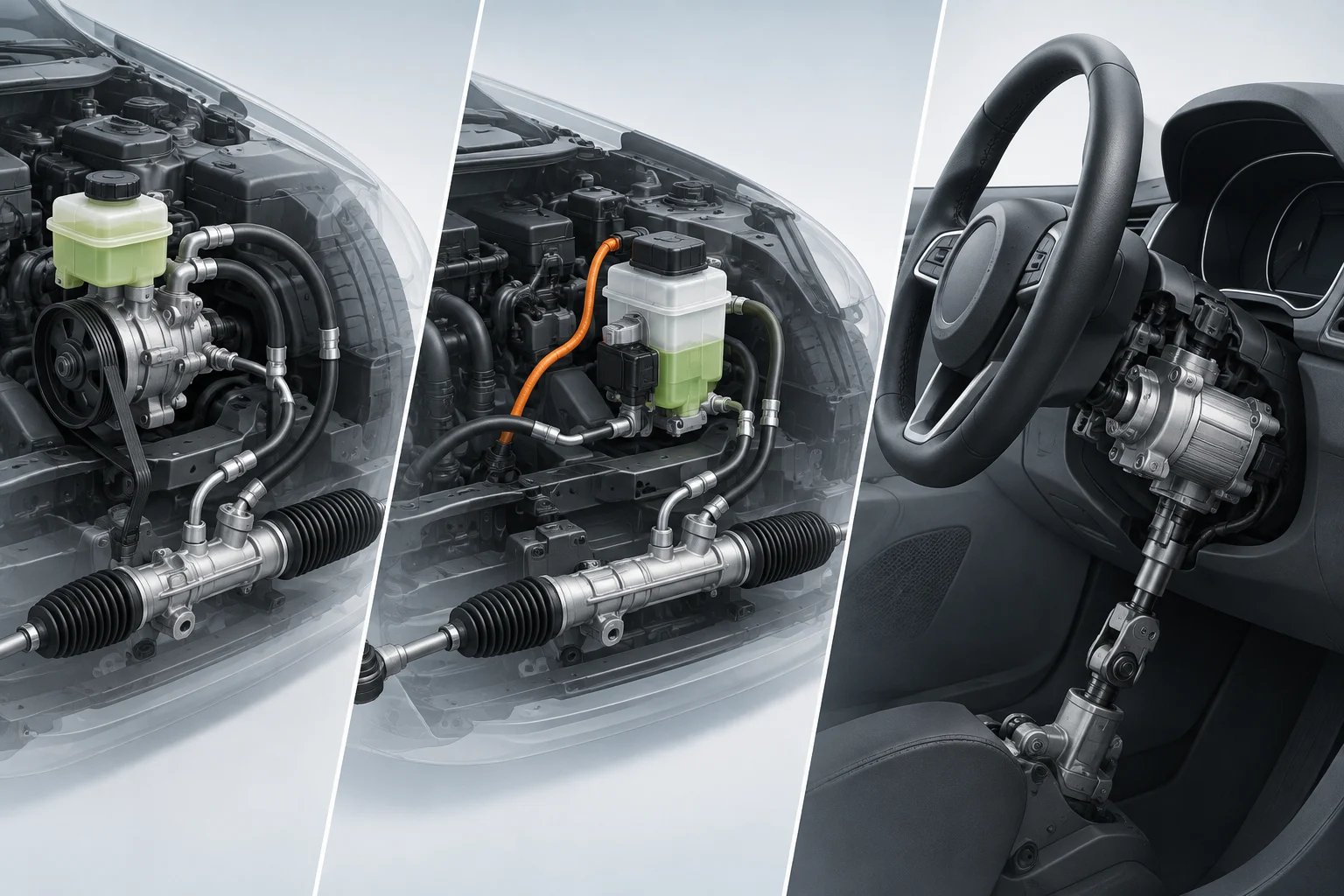
In a conventional hydraulic power steering, a pump — usually driven by the engine — pushes fluid under pressure. When turning the steering wheel, a valve directs the fluid to one side of the rack to help orient the wheels.
Electro-hydraulic systems maintain the fluid, pipes, and hydraulic mechanism, but the pump is driven by an electric motor. Therefore, an electrically driven pump does not mean the system lacks liquid.
In electric power steering, a motor provides assistance on the column, pinion, or rack. There is no hydraulic fluid or associated lines. Toyota highlights general advantages of this technology, such as reduced weight and components, as well as its potential to integrate assistance functions.
| System | How it generates assistance | Uses hydraulic fluid? |
|---|---|---|
| Hydraulic | A pump pushes fluid under pressure; usually driven by the engine. | Yes |
| Electro-hydraulic | An electric motor drives a pump that maintains the hydraulic circuit. | Yes |
| Electric | A motor helps move the column, pinion, or rack. | No |
Section references: ¿Cómo funciona el sistema de dirección hidráulica de un coche? ↗ · Dirección asistida eléctrica o hidráulica ↗

How to identify it when comparing cars
Start with the technical documentation corresponding to the model, year, and version: look for the description of the steering system or consult an official service with those details. In a used car, you can also ask for the technology to be confirmed in the sheet or maintenance documentation.
At a glance, a pump and hydraulic lines, along with a fluid reservoir identified in the manual, point to a hydraulic or electro-hydraulic system. To distinguish them, you must confirm how the pump is driven: in the former, it is usually mechanically connected to the engine; in the latter, it is moved by an electric motor. The presence of electrical components is not enough to classify it.
If the documentation indicates electric assistance and specifies a motor on the column, pinion, or rack, there should be no hydraulic fluid circuit. Do not try to identify parts by touching hot or moving elements, or open reservoirs without following the manufacturer's instructions. The appearance of an isolated component can be misleading; verify the complete architecture in the information for the specific version.
Section references: ¿Cómo funciona el sistema de dirección hidráulica de un coche? ↗
- Note the make, model, year, and version before searching for technical information.
- Check if the documentation mentions a hydraulic pump, electro-hydraulic pump, or electric assistance.
- Use the feel of the steering wheel only as a driving impression, not as proof of which system is installed.
What to consider and when to request a review
When comparing cars of different generations, evaluate the behavior of the specific vehicle, its history, and the condition of the steering, not just the name of the system. Hydraulic systems incorporate fluid and lines; electric systems dispense with that circuit and may have fewer components according to Toyota's general description. This does not allow you to automatically deduce which will be more reliable or cheaper to repair: the diagnosis and cost depend on the car and the fault.
If a hydraulic power steering stiffens, hums, or responds in jerks, these symptoms do not confirm by themselves that the pump is faulty. A leak, low level, or air in the circuit can produce similar signs. In case of changes in effort, noises, or irregular response, request a professional review; do not replace parts based solely on the symptom.
For a second-hand purchase, ask to check the operation and review the maintenance history. If there is an anomaly, it is advisable to resolve it before deciding: knowing the technology helps guide questions, but it does not replace an inspection of the vehicle.
Section references: ¿Cómo funciona el sistema de dirección hidráulica de un coche? ↗ · Dirección asistida eléctrica o hidráulica ↗
Does electro-hydraulic power steering have liquid?
Yes. It maintains the fluid, pipes, and hydraulic mechanism; what changes is that an electric motor drives the pump.
Can you tell what steering a car has by how the wheel feels?
Not reliably. The feel is not enough to identify the architecture; check the technical documentation of the specific version and confirm its components.
Does a hum in hydraulic power steering mean the pump is failing?
Not necessarily. A leak, low level, or air in the circuit can cause similar symptoms. If the effort or response changes, request a professional review.