EV charger in a community garage: what to check
The legal possibility of installing a charger does not guarantee that the parking space has a simple or sufficient solution for your routine. These are the key checks before choosing an electric car or plug-in hybrid.
Key points
Living in a homeowners' association does not prevent installing a charging point in an individual parking space: in Spain, prior notification to the community is sufficient. Before buying, also check the cable route, supply, useful power, and installation cost.
The space can have a charger, but will it serve you daily?
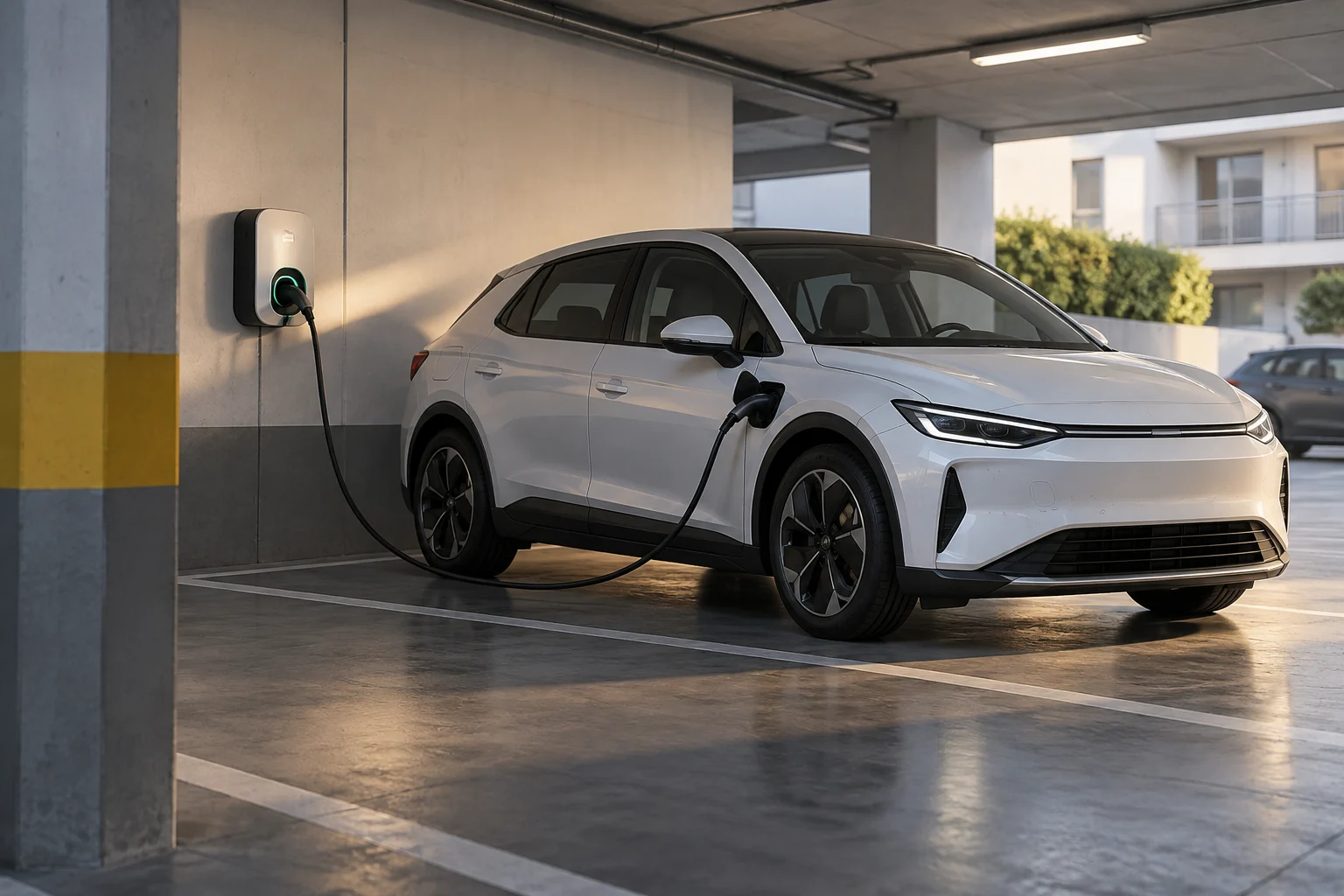
In Spain, a person can install a private-use charging point in their individual parking space in a community garage with prior notification to the community; they do not need to submit it to a vote. The interested party assumes the cost of the installation and the electricity consumed. But being able to do so does not mean that any space has the same cable route, supply, or cost, nor that the available power covers all needs.
Therefore, before choosing an electric car or plug-in hybrid, it is advisable to confirm how the charger would be powered and how long the vehicle would have to charge. Daily viability depends on combining the intended use with the actual installation of the building and with the maximum power that the vehicle admits in alternating current.
Section references: Cargador coche eléctrico garaje comunitario: guía positiva para instalarlo sin complicaciones ↗ · ¿Cómo instalar un punto de carga en un garaje comunitario? ↗

Space, cable route, and meter
Ask a qualified installer to review the space and the possible route from the supply to the charging point. The distance and route through common areas condition the work and the budget; it is not enough to know that there is a socket or that there is electricity in the garage.
If the space is in the same building as the residence, connecting the equipment to the domestic meter is usually a simpler option: the consumption remains on the user's bill. It is not an automatic solution for all buildings. Ask which meter would power the charger, how the consumption would be measured, and what elements would have to be installed. The installation must comply with the applicable technical regulations; ITC-BT 52 is part of the low-voltage electrical regulation.
Request a quote that describes the route, the equipment, and the work included. This will allow you to compare proposals on the same basis and distinguish the cost of the charger from that of bringing power to your space.
Section references: Cargador coche eléctrico garaje comunitario: guía positiva para instalarlo sin complicaciones ↗ · ¿Cómo instalar un punto de carga en un garaje comunitario? ↗

Power: relate it to your trips and parking hours
Do not choose the charger power only by a commercial figure. To assess what suits you, gather the kilometers you usually make, the hours the car remains parked, the battery capacity, and the maximum charging power in alternating current that the vehicle admits. Add the contracted power and the other electrical consumptions that coincide with the charge.
A single-phase installation can admit a station of up to 7.4 kW if the installation itself, the contracted power, and the car allow it; it is not a guaranteed power for all spaces. Load balancing is another option that can temporarily adjust the power destined to the vehicle according to the simultaneous consumption of the installation. Ask if the proposed equipment incorporates it and how it affects charging in your usual schedules.
Section references: Cómo elegir un cargador para coche eléctrico: potencia, protecciones y accesorios ↗
Notification to the community and contracting
For an installation in an individual space, the Horizontal Property Law establishes prior notification to the community, not an authorization subject to a vote. Do it in writing and keep a record. It can indicate who requests the installation, the number or location of the space, the type of charger planned, and the company or professional that will carry out the work.
The notification does not replace the technical review or the contracting of a qualified professional. Before accepting a quote, ask that the route, the supply, the planned power, the meter or measurement system, and the work included be specified. The technical conditions depend on the building and the installation; confirm with the installer what documentation corresponds to your case.
Section references: Cargador coche eléctrico garaje comunitario: guía positiva para instalarlo sin complicaciones ↗ · ¿Cómo instalar un punto de carga en un garaje comunitario? ↗
If home charging does not fit
If the route is complex, the supply does not cover your needs, or the space does not allow a solution that suits you, compare alternatives before deciding on the car: shared charging points in the building or public charging near home, work, or your usual destinations. Convenience depends on their availability for your schedules and whether you can leave the vehicle charging for the necessary time.
Note how many charges you would need in a normal week, when you could perform them, and what trips would require an additional charge. If you depend on charging outside the home, check that that routine is compatible with your trips before considering the purchase viable.
Data to request quotes and compare cars
Bring specific information to the technical visit. With it, the installer can assess the solution and you can contrast the proposal with the vehicle you have in mind, without confusing the nominal power of the charger with the effective charging power.
Section references: Cargador coche eléctrico garaje comunitario: guía positiva para instalarlo sin complicaciones ↗ · Cómo elegir un cargador para coche eléctrico: potencia, protecciones y accesorios ↗
- Number and location of the space, and whether it is in the same building as your residence.
- Possible route from the meter or supply to the space; ask the installer to confirm it on site.
- Meter that would power the point and how to measure individual consumption.
- Contracted power, type of supply, and other coincident electrical consumptions, if known.
- Usual kilometers, hours available to charge, and battery capacity of the car considered.
- Maximum charging power in alternating current admitted by that vehicle.
- Description of the charger, planned power, load balancing if proposed, and work included in each quote.
- Data to include in the prior notification to the community and documentation that the installer indicates for the specific installation.
Do I need permission from the community to install a charger in my space?
For a private-use charging point in an individual space, the Horizontal Property Law establishes that it is enough to notify the community in advance; a favorable vote is not necessary. The cost of the installation and consumption corresponds to the interested party.
Does the community pay for the installation or electricity?
In a private installation in an individual space, the cost of the installation and electrical consumption corresponds to the person who requests it.
Is a 7.4 kW charger suitable for any car or garage?
Not necessarily. That power can be suitable in certain single-phase installations, but it depends on the installation, the contracted power, and the alternating current charging power that the vehicle admits.
Who must install the charging point?
The installation must be carried out by a qualified installer, who can check the conditions of the garage and adjust the work to the applicable technical regulations.