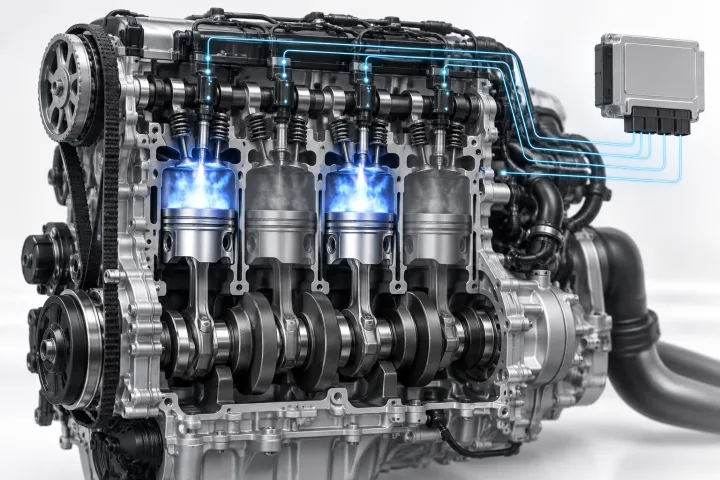
Diesel Particulate Filter Regeneration: What Happens
The filter retains soot and eliminates it through passive or active regenerations. We explain the signs you might notice, how urban use influences the process, and when to consult the manual or a workshop.

Key points
Regeneration raises exhaust temperature to burn soot retained in the diesel particulate filter. Short trips can hinder completion; signals and conditions vary by vehicle.
What the particulate filter does
The particulate filter is integrated into the exhaust and retains solid particles produced during combustion while allowing gases to pass. With use, soot accumulates in the filter; regeneration raises the exhaust temperature to burn it off and restore filtering capacity.
Regeneration is a vehicle management function, not a filter repair. Its specific operation depends on the design and electronic strategy of each engine.
Section references: Filtro de partículas: qué es y cómo solucionar (y evitar) averías ↗ · Filtro de partículas: qué es, cómo funciona y cómo afecta a las emisiones diésel ↗

Passive and active regeneration
Passive regeneration can occur when normal operating conditions keep the exhaust at a sufficient temperature for the required time. In active regeneration, the electronics intervene when they detect the need to raise the temperature to reduce accumulated soot.
There is no single driving condition valid for all cars: the strategy and parameters depend on the manufacturer and the engine. To know how a specific vehicle manages this process, consult its manual.
| Type | How it occurs |
|---|---|
| Passive | Operating conditions reach sufficient temperature for an adequate period. |
| Active | The vehicle's electronics manage the temperature increase when they detect the need to reduce accumulation. |
Section references: Filtro de partículas: qué es, cómo funciona y cómo afecta a las emisiones diésel ↗

Signs the driver may notice
Some vehicles may display a specific warning light or a message related to the engine. Loss of power, increased fuel consumption, or more frequent regenerations may also appear. These signs depend on the car and the degree of saturation: not all models indicate them in the same way, nor does their presence alone confirm that the filter is the cause.
A fault warning deserves attention as such; it is not advisable to assume it is a normal regeneration. The same symptoms can be related to other systems and require joint interpretation with diagnosis.
Section references: Filtro de partículas: qué es, cómo funciona y cómo afecta a las emisiones diésel ↗
- The way a regeneration or problem is indicated can vary by model.
- If a warning light or message appears, consult the manual for its meaning and specific instructions for your vehicle.
Why urban trips can have an impact
Short routes and urban use can cause the vehicle to spend long periods without reaching the conditions necessary to complete a regeneration. If active regenerations are repeatedly interrupted, filter saturation may increase.
This does not mean that all urban driving causes a failure. Usage conditions and the specific strategy of the car are important. If the vehicle repeats warnings or presents symptoms, do not try to compensate by accelerating while stationary: follow the manual's instructions and request a check-up if the problem persists.
Section references: Filtro de partículas: qué es, cómo funciona y cómo afecta a las emisiones diésel ↗
When to consult a workshop
If the warning persists, reappears, or is accompanied by loss of power or other symptoms, it is advisable to request a professional check-up. A check may include fault codes, estimated saturation, differential pressure, sensors, and regeneration history, in addition to normal usage conditions.
Provide the workshop with when the warning appears, what routes you usually take, and whether you have noticed changes in behavior or consumption. This information helps assess the whole picture, without assuming that the filter is necessarily the origin of the problem.
Section references: Filtro de partículas: qué es, cómo funciona y cómo afecta a las emisiones diésel ↗
What is the difference between passive and active regeneration?
Passive regeneration takes advantage of normal conditions that reach sufficient temperature for an adequate time. In active regeneration, the vehicle's electronics manage a temperature increase when they detect the need to reduce soot.
Can a regeneration be interrupted by short trips?
Urban use and short routes can make it difficult to reach the necessary conditions. Repeated interruptions of active regenerations can increase saturation.
Does a warning light mean the filter is faulty?
Not necessarily. Signs can have other causes; consult the manual for the meaning of the warning and request a professional diagnosis if it persists or is accompanied by other symptoms.