Auxiliary Battery for Camper Cars: Installation and Homologation Guide
Learn how to choose the right auxiliary battery for your camper, calculate energy needs, and discover legal homologation requirements in Spain to avoid issues during vehicle inspections.
Key points
Learn how to select the correct auxiliary battery for your camper van, calculate your energy needs, and understand the legal homologation requirements in Spain to ensure a safe and compliant installation.
Difference Between Starting Battery and Auxiliary Battery
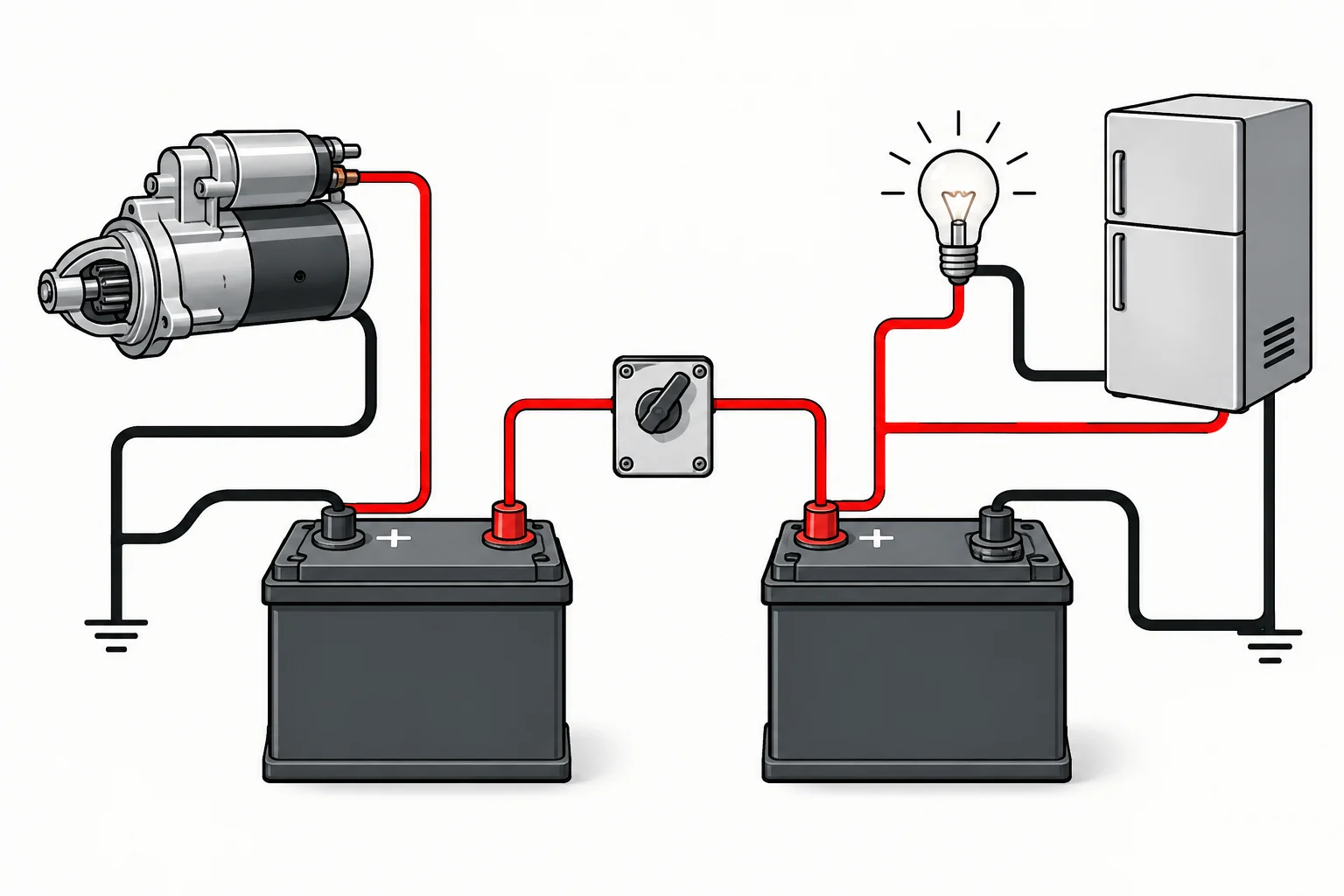
In a camper vehicle, energy management is divided into two main circuits. The starting battery, or engine battery, is designed to provide intense current for a few seconds to activate the starter motor. Its chemistry and structure are optimized for this power peak, not for maintaining stable voltage for hours.
The auxiliary battery, also known as the service or camping battery, powers the electrical consumption of the living area: lighting, refrigerator, fans, water pumps, or electronic devices. Its function is to maintain constant voltage during prolonged periods without relying on the vehicle's engine. Confusing these two functions can damage the starting battery or leave the user without energy for basic services.
It is crucial that both batteries are electrically isolated using a separation system (relay or DC-DC booster) to prevent the auxiliary battery from discharging the starting battery when the engine is off.
Section references: BATERÍA AUXILIAR para furgoneta camper y autocaravana ↗
- Starting battery: Optimized for high, short-duration current peaks.
- Auxiliary battery: Optimized for slow, sustained discharges over time.
- Isolation: Necessary to protect the starting battery from parasitic discharges.
How to Estimate the Energy Needed for Your Consumption
Before choosing a battery, it is essential to inventory the devices that will be used during the stay. Energy is measured in watt-hours (Wh). To calculate the daily demand, multiply the power of each device (in watts) by the estimated hours of use.
For example, a 50W refrigerator that runs on average 8 hours a day consumes 400Wh. If you add 10W LED lighting for 4 hours (40Wh) and a 60W laptop for 2 hours (120Wh), the total daily consumption would be 560Wh. For a 3-day autonomy, the battery should store at least 1,680Wh.
It is important to consider that system efficiency is not 100%. If an inverter is used to convert direct current (DC) to alternating current (AC), approximately 10-15% of energy is lost in conversion. This margin must be added to the initial calculation to avoid insufficient capacity.
| Device | Power (W) | Hours/day | Consumption (Wh) |
|---|---|---|---|
| Refrigerator | 50 | 8 | 400 |
| LED Lighting | 10 | 4 | 40 |
| Laptop | 60 | 2 | 120 |
| Daily Total | - | - | 560 |
Section references: BATERÍA AUXILIAR para furgoneta camper y autocaravana ↗
- List all devices and their power in watts (W).
- Estimate the daily hours of use for each.
- Sum the total daily watt-hours (Wh).
- Multiply by the desired days of autonomy.
- Add a 10-15% margin if using an inverter.

Nominal Capacity vs. Usable Capacity
A common mistake is assuming that the nominal capacity (in Ampere-hours, Ah) indicated by the manufacturer is the total available energy. The real capacity of a battery depends on the discharge rate, known as the C-rate. The higher the discharge rate, the lower the effective capacity that can be extracted.
For example, a 160Ah battery at C100 rate (discharge in 100 hours) may offer only 130Ah at C10 rate (discharge in 10 hours) and only 85Ah at C1 rate (discharge in 1 hour). For camper applications, where discharges are slow, the C10 or C20 rate is the most relevant.
Furthermore, not all capacity is usable without damaging the battery. In lead-acid batteries, it is recommended not to exceed a 50% depth of discharge (DoD) to prolong their lifespan. This means that from a 100Ah battery, only 50Ah are truly usable safely and repeatedly.
Section references: BATERÍA AUXILIAR para furgoneta camper y autocaravana ↗
- Capacity decreases as the discharge rate increases.
- In lead-acid, limit discharge to 50% for greater durability.
- In LiFePO4, the usable depth of discharge is higher (up to 80-90%).
Battery Types: AGM, Gel, and LiFePO4
AGM (Absorbent Glass Mat) batteries are an evolution of lead-acid batteries. The electrolyte is absorbed in a fiberglass mesh, allowing them to be installed in any position, even lying down, without risk of spills. They are sealed and require no water maintenance, making them a popular option due to their balance between price and performance.
Gel batteries are similar in concept but use a gelled electrolyte. They are also sealed and resistant to vibration, although they are usually more sensitive to extreme temperatures and deep discharges than AGM batteries.
LiFePO4 (Lithium Iron Phosphate) batteries offer significant advantages: greater capacity for the same weight and size, greater voltage stability during discharge, and a much longer lifespan, with up to 4,000 charge and discharge cycles. However, they require a certified battery management system (BMS) and are more expensive initially.
| Characteristic | AGM | Gel | LiFePO4 |
|---|---|---|---|
| Maintenance | None | None | None |
| Installation Position | Any | Any | Any |
| Life Cycles | 500-1000 | 500-1000 | Up to 4000 |
| Depth of Discharge | 50% | 50% | 80-90% |
Section references: BATERÍA AUXILIAR para furgoneta camper y autocaravana ↗
- AGM: Sealed, maintenance-free, installable lying down.
- Gel: Sealed, vibration-resistant, sensitive to temperature.
- LiFePO4: Higher energy density, more life cycles, requires certified BMS.
Charging System Compatibility and Protection
The choice of battery must be accompanied by a compatible charging system. For LiFePO4 batteries, it is mandatory to use an MPPT solar regulator with a specific profile for lithium and a DC-DC booster designed for this chemistry. A standard PWM regulator or a conventional separation relay can damage the BMS of the lithium battery if the input current exceeds its limits.
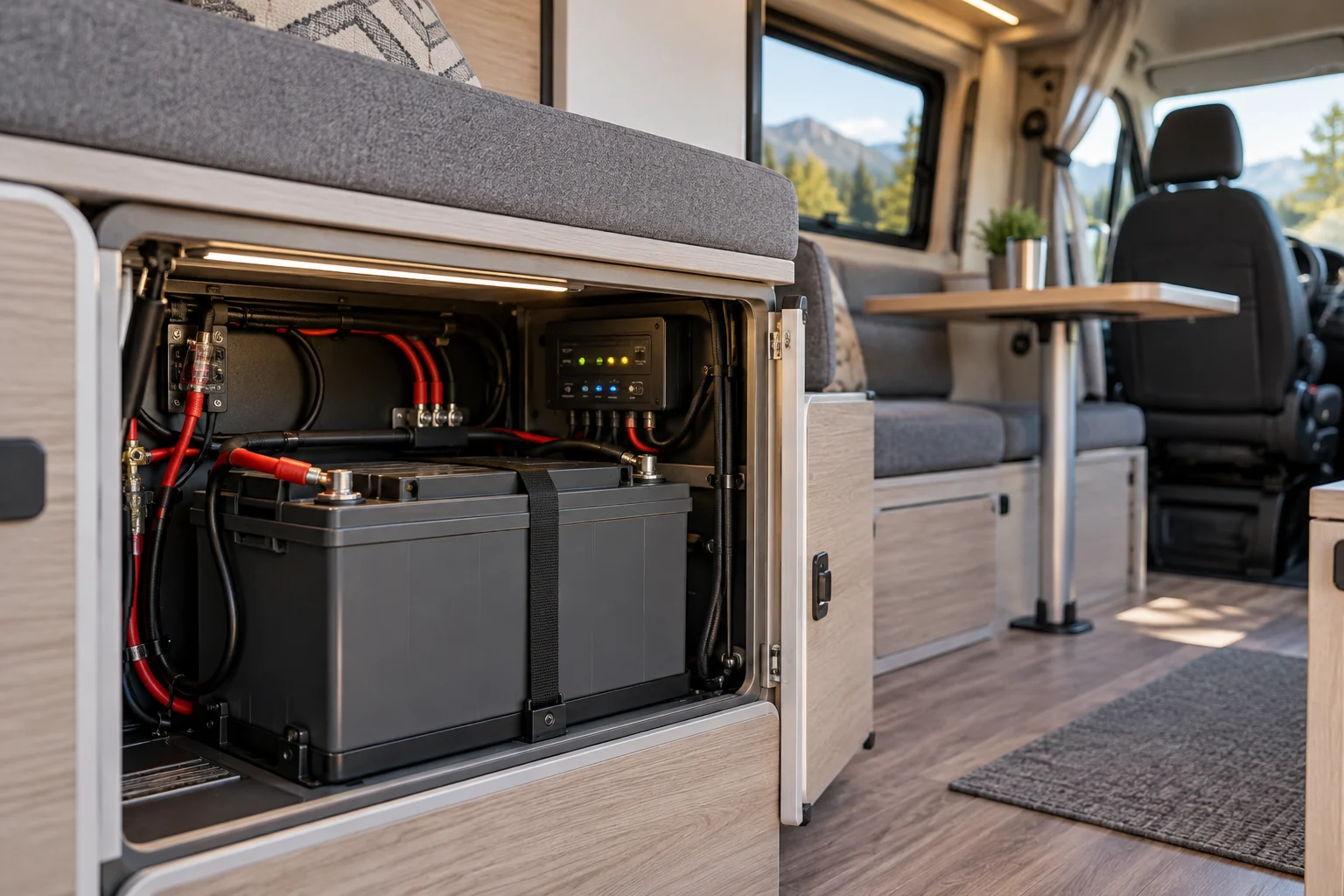
Protection against short circuits is vital. The protection fuse must be installed as close as possible to the positive terminal of the auxiliary battery. This minimizes the length of exposed cable and reduces the risk of fire in case of failure.
The physical location of the battery is also critical. It must be in a cool, dry place with good ventilation, away from heat and moisture sources. Liquid acid batteries cannot be placed lying down and usually require external installation, while AGM and LiFePO4 can be installed internally if ventilation standards are met.
Section references: Cómo elegir e instalar una batería auxiliar en una camper ↗ · Homologar Batería LiFePO4 en Camper: ¿Es Obligatorio? ↗
- LiFePO4 requires specific MPPT regulator and DC-DC booster.
- Fuse near the positive terminal of the auxiliary battery.
- Location cool, dry, and ventilated, away from heat.
Homologation and Legal Documentation in Spain
In Spain, the installation of a second battery in a camper vehicle is considered a significant modification. Therefore, it must be homologated to be used legally during driving. This is especially relevant for passing the Technical Vehicle Inspection (ITV).
Since Revision 7 of the Modification Manual (November 2022), any auxiliary battery installed inside the cabin or vehicle must be included in the modification project and documented with an electrical certificate. This document must be issued by a competent technician and detail the installation, components used, and safety measures.
For LiFePO4 batteries, the BMS must be integrated, certified, and documented. If the BMS does not meet the requirements, the battery cannot be homologated. Additionally, the solar regulator must be compatible with the battery chemistry; if a LiFePO4 battery is declared but a standard PWM regulator is installed, the electrical certificate will not pass inspection.
Section references: Cómo elegir e instalar una batería auxiliar en una camper ↗ · Homologar Batería LiFePO4 en Camper: ¿Es Obligatorio? ↗
- The installation must be homologated for use in driving.
- Requires a modification project and electrical certificate.
- The BMS of lithium batteries must be certified.
- The solar regulator must be compatible with the battery chemistry.
Alternatives: Portable Batteries and Modular Systems
For those who do not want to perform a fixed or homologated installation, portable lithium batteries (power station type) offer a practical alternative. These systems are modular, easy to install, and do not require an electrical certificate if used as removable devices, provided they are not part of the vehicle's fixed circuit.
However, they have limitations: lower total capacity than a fixed installation, longer charging time, and higher cost per watt-hour. They are ideal for weekend getaways or for users who prioritize flexibility and ease of use over maximum autonomy.
The decision between a fixed homologated installation and a portable system depends on autonomy needs, budget, and willingness to handle legal paperwork. A fixed installation offers greater capacity and efficiency in the long term, while a portable system offers greater flexibility and lower initial complexity.
- Portable batteries: Do not require homologation if removable.
- Lower capacity and higher cost per Wh.
- Ideal for short getaways or users who prioritize flexibility.
Do I need to homologate the auxiliary battery if I only use it while parked?
Yes. Spanish regulations consider the installation of a second battery a significant modification that must be homologated for legal use in the vehicle, regardless of whether it is used during driving or not. It is necessary to pass the ITV.
Can I install a LiFePO4 battery with a PWM solar regulator?
It is not recommended and can invalidate the homologation. LiFePO4 batteries require an MPPT regulator with a specific profile for lithium. A standard PWM regulator can damage the battery's BMS, and the electrical certificate will not pass inspection if this incompatibility is detected.
How long does an AGM battery last in a camper?
The lifespan of an AGM battery depends on the depth of discharge and usage conditions. If a 50% depth of discharge is respected, it can last between 500 and 1000 cycles. Proper management of charge and temperature can prolong its lifespan.
Where should I place the auxiliary battery?
It must be in a cool, dry place with good ventilation, away from heat and moisture sources. AGM and LiFePO4 batteries can be installed internally if ventilation standards are met, while liquid acid batteries require external installation and cannot be placed lying down.