How a Car Works: A Beginner's Guide to Vehicle Systems
Discover how the engine, transmission, brakes, steering, and suspension interact. A clear guide to understanding basic automotive mechanics and exploring careers in the sector.
Key points
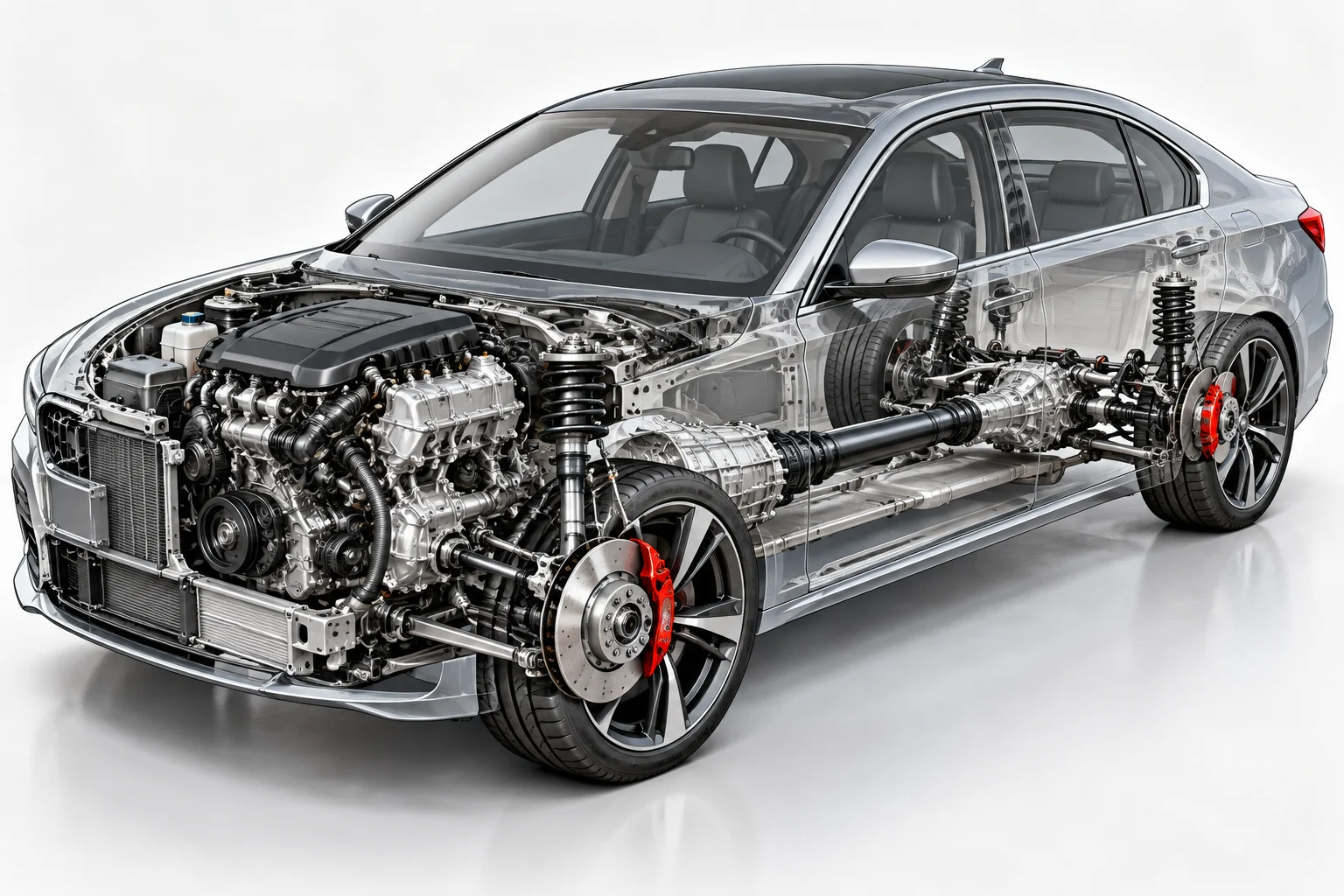
This guide explains the main systems of a car for students and enthusiasts: engine, transmission, brakes, steering, suspension, and cooling. It details how they interact to move, control, and stop the vehicle, with a basic glossary and links to training resources.
Introduction: The Main Systems of a Car
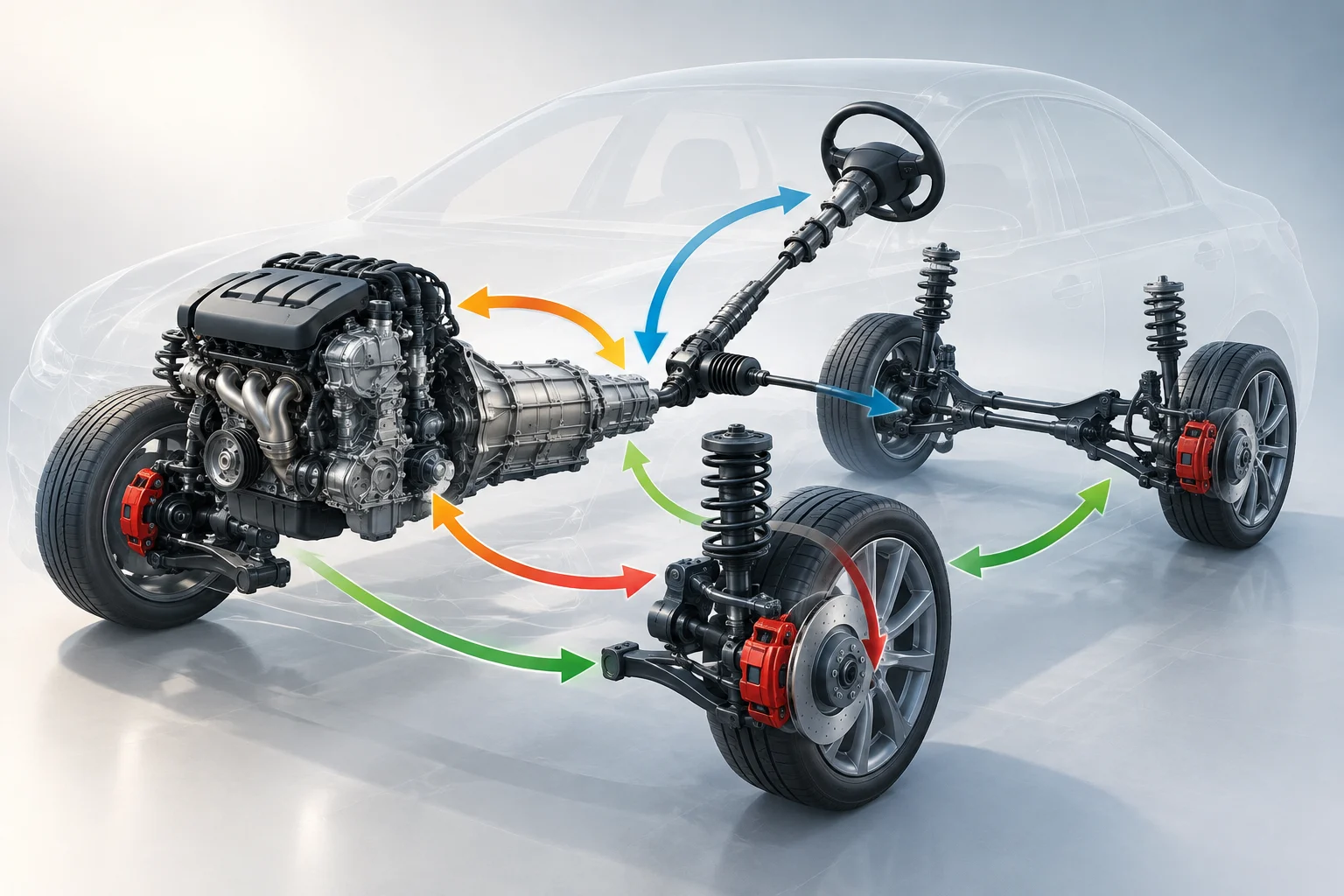
To understand how a car works, it is useful to divide the vehicle into major systems that work together. The engine generates the force needed to move the vehicle, while the transmission sends that energy to the wheels. The braking, steering, and suspension systems allow control of movement and maintain stability on the road.
This guide is designed for vocational training students and those interested in automotive careers. It does not replace workshop manuals or specific manufacturer repair instructions, but it provides a clear conceptual foundation for understanding the interaction between components.
Section references: How Cars Work: Vehicle Systems Explained (With Diagram) ↗
- Engine and transmission: generate and transmit power.
- Brakes: stop the vehicle by converting kinetic energy into heat.
- Steering: directs the wheels to change trajectory.
- Suspension: keeps the wheels in contact with the ground.
- Cooling: regulates the engine temperature.
Engine and Transmission: From Energy to Motion
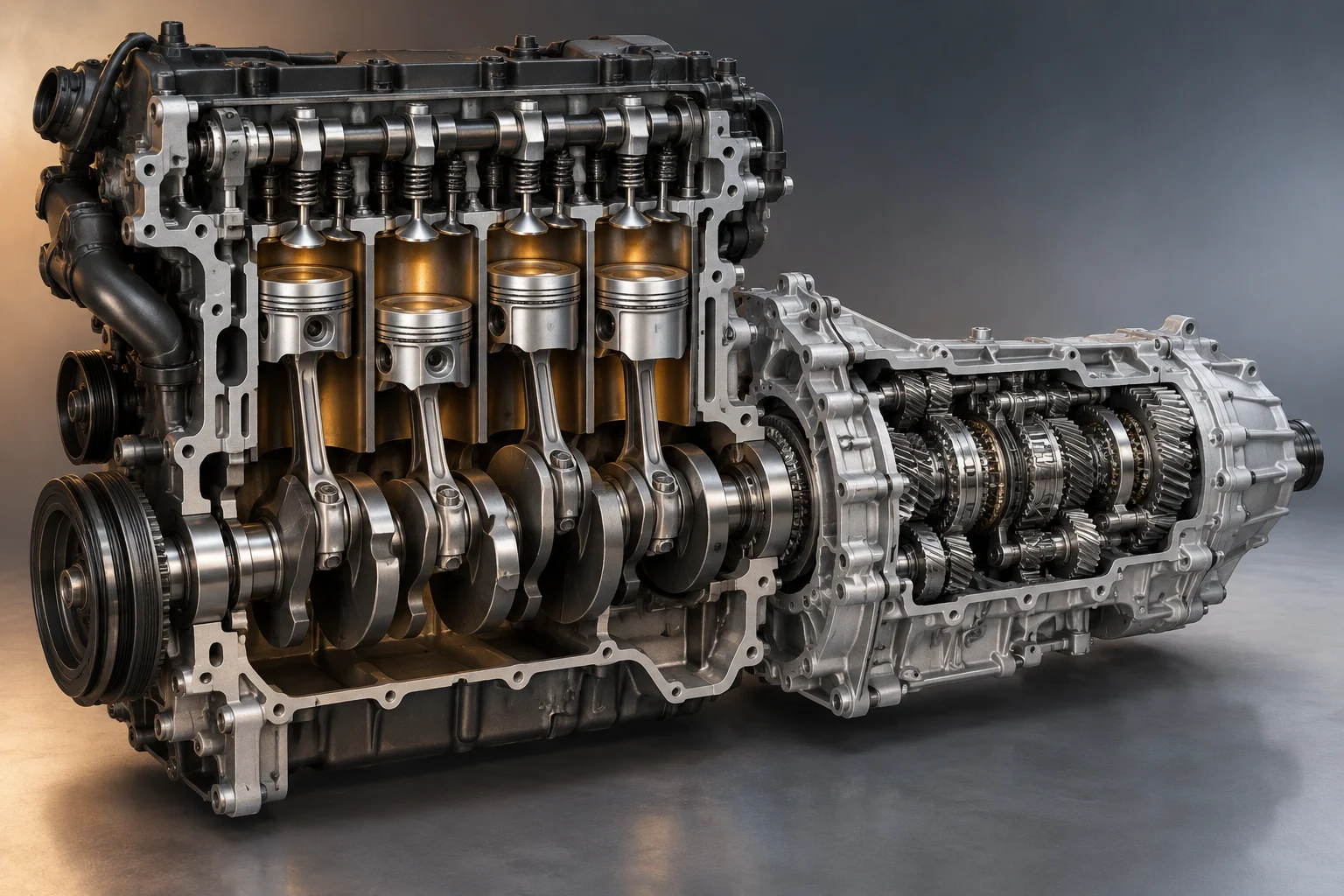
The internal combustion engine converts the chemical energy of fuel into mechanical energy. This is achieved through the controlled explosion of the air-fuel mixture inside the cylinders, which pushes the pistons. The pistons are connected to connecting rods that rotate the crankshaft, transforming linear motion into rotary motion.
The transmission is the system that sends the engine's power to the wheels. In front-wheel-drive vehicles, the gearbox and differential are usually integrated into a single unit. In rear-wheel-drive or all-wheel-drive vehicles, a driveshaft connects the gearbox to the rear axle. The differential allows the left and right wheels to rotate at different speeds when cornering, preventing premature tire wear.
Section references: Automotive Systems Technology A.A.S. ↗ · How Cars Work: Vehicle Systems Explained (With Diagram) ↗
- Pistons and connecting rods: convert combustion pressure into motion.
- Crankshaft: transforms linear motion into rotary motion.
- Gearbox: adjusts the torque and speed ratio.
- Differential: allows speed difference between wheels.
Brakes, Steering, and Suspension: Control and Stability
The braking system is crucial for safety. When the pedal is pressed, hydraulic pressure acts on the pads or shoes, which rub against the discs or drums. This friction converts the vehicle's kinetic energy into heat, reducing its speed. Modern systems include ABS (Anti-lock Braking System) to maintain control during hard braking.
Steering allows the driver to direct the wheels. In most cars, the steering wheel turns a steering column that, through a rack or a hydraulic/electric system, moves the front wheels. The suspension, on the other hand, connects the body to the wheels. It absorbs road irregularities using springs and shock absorbers, keeping the wheels in contact with the asphalt to improve grip and comfort.
Section references: How Cars Work: Vehicle Systems Explained (With Diagram) ↗
- Discs and pads: main components of the disc brake.
- Steering column: transmits the steering wheel's movement to the wheels.
- Springs and shock absorbers: absorb impacts and control rebound.
- ABS: prevents wheel lockup during emergency braking.
Cooling and Other Support Systems
The engine generates a large amount of heat during operation. The cooling system prevents overheating through a coolant circuit that circulates through the engine block and passes through a radiator, where it is cooled by airflow. A water pump drives the liquid and a thermostat regulates its temperature.
In addition to these systems, the car has electrical and electronic systems that manage ignition, fuel injection, and comfort and safety functions. In hybrid and electric vehicles, battery and electric motor management adds an additional layer of complexity, but the principles of motion and braking control remain similar.
Section references: Automobile Program Standards ↗
- Radiator: dissipates heat from the coolant.
- Water pump: circulates the liquid through the circuit.
- Thermostat: regulates operating temperature.
- Electrical system: powers sensors and actuators.
Basic Glossary and Resources for Further Learning
To delve deeper into the sector, it is recommended to familiarize yourself with technical terminology. The ASE Education Foundation standards, updated in 2026, define competency levels such as Maintenance and Light Repair (MLR), Automotive Service Technician (AST), and Master Technician (MAST). These reference frameworks are useful for planning a career in mechanics.
It is recommended to consult manufacturer manuals for specific tasks and avoid performing complex repairs without adequate training. Online educational resources and vocational training programs offer a solid foundation for those who wish to work in the sector.
| System | Main Function | Key Components |
|---|---|---|
| Engine | Generate power | Pistons, crankshaft, cylinder head |
| Transmission | Send power to wheels | Gearbox, differential, axle |
| Brakes | Stop the vehicle | Discs, pads, brake pump |
| Steering | Direct the wheels | Steering wheel, column, rack |
| Suspension | Maintain ground contact | Springs, shock absorbers, arms |
| Cooling | Regulate temperature | Radiator, pump, thermostat |
Section references: Automobile Program Standards ↗ · Automotive Systems Technology A.A.S. ↗
- Torque: rotational force generated by the engine.
- Transmission: set of parts that send power to the wheels.
- Shock absorber: component that controls suspension movement.
- Coolant: liquid that absorbs and dissipates engine heat.
What is a differential and why is it important?
The differential is a gear that allows the left and right wheels to rotate at different speeds when cornering. This is necessary because the outer wheel travels a greater distance than the inner one, preventing tire wear and improving stability.
How does the cooling system work?
The cooling system uses a liquid that circulates through the engine to absorb generated heat. This liquid passes through a radiator, where it is cooled by airflow, and returns to the engine to repeat the cycle. A thermostat regulates the temperature so the engine operates in its optimal range.
What is the difference between front-wheel and rear-wheel drive?
In front-wheel drive, the engine and transmission are at the front and send power to the front wheels. In rear-wheel drive, the engine is at the front but power is sent to the rear wheels via a driveshaft. All-wheel drive sends power to all four wheels.
Is it safe to perform repairs at home without training?
It is recommended to perform only basic maintenance tasks if you have the appropriate knowledge and tools. For complex repairs, it is best to go to a professional workshop to avoid vehicle damage or safety risks.