Classic Car Auction Guide: How It Works, Fees, and Risks
Learn how to navigate classic car auctions: how bidding works, how to calculate the final price with fees and taxes, and what documentation to verify to avoid surprises.
Key points
Classic car auctions offer price transparency but require rigorous preparation. This guide explains how in-person and online processes work, how to calculate the true total cost including fees, taxes, and transport, and which documents are essential to validate the vehicle's history before bidding.
How Classic Car Auctions Work
Classic car auctions are primarily divided into two modalities: in-person auctions organized by traditional auction houses, and online auctions that allow bidding from anywhere. In both cases, the process begins with the registration of the lot and the publication of an appraisal or starting price.
To participate, the buyer must meet guarantee requirements. On online platforms like Benzin, this involves registering a bank card with a security hold, typically ranging from €300 to €1,000. In in-person or judicial auctions in Spain, it is common to constitute a security deposit (bond) that can represent between 5% and 20% of the vehicle's appraised value.
Once the auction begins, bids are binding. This means that, upon winning the lot, the buyer is obligated to complete the purchase. Withdrawing the bid after winning can result in significant financial penalties, such as the payment of full service fees.
Section references: Benzin: Comprar un coche en una subasta online ↗ · Diario de Subastas: Comprar un coche clásico ↗
- Modalities: In-person (auction houses) and Online (digital platforms).
- Guarantee: Bank hold (online) or percentage bond (in-person).
- Binding: The winning bid obligates immediate purchase.
Fees and Hidden Costs: The Real Final Price
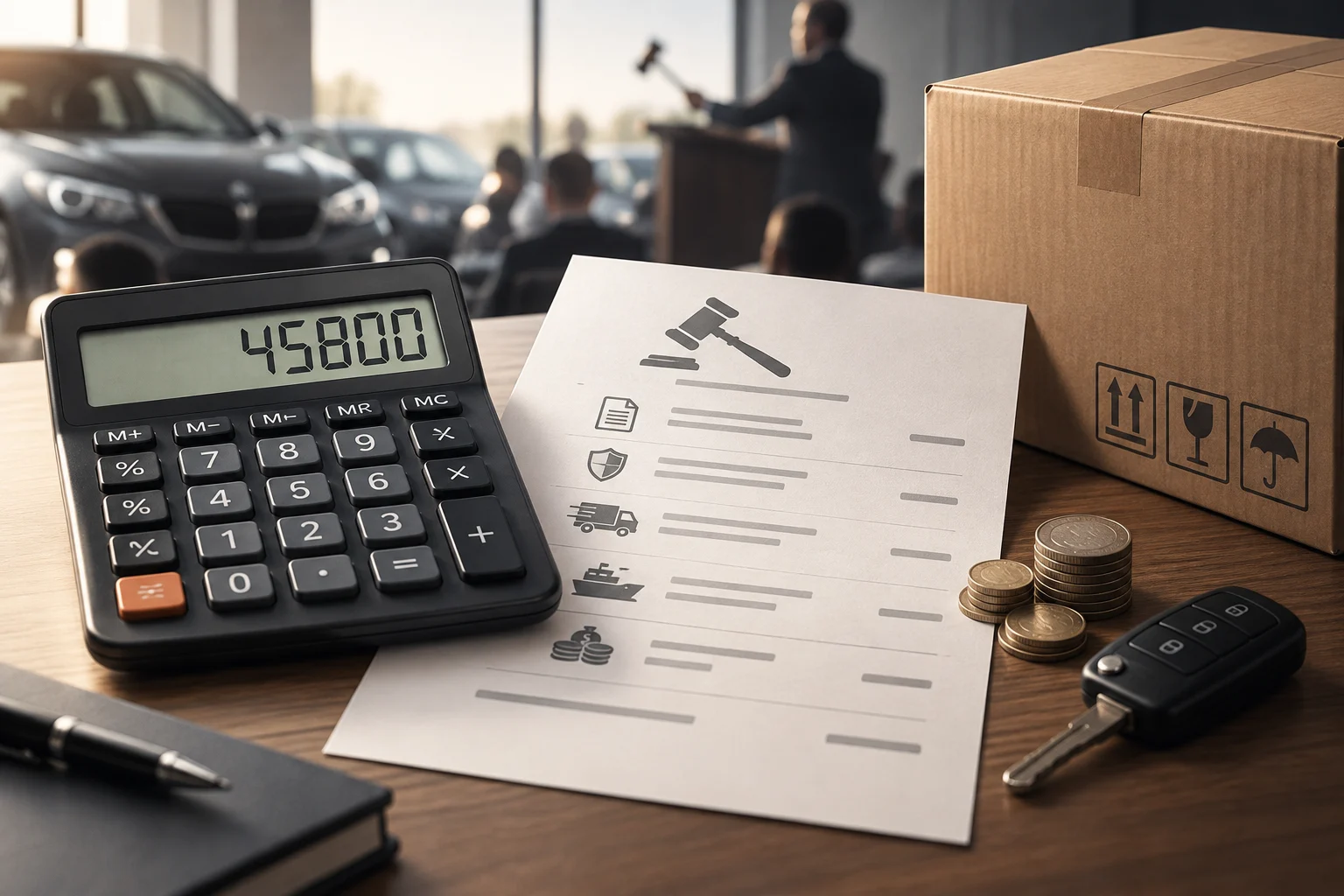
The most common mistake in auctions is confusing the hammer price with the total cost. The final price includes the hammer, buyer's commissions, taxes, and, in the case of international auctions, transport and registration.
Commissions vary by platform. For example, on Benzin, the buyer's commission is 3.9% (VAT included) of the final price, with a minimum of €199 and a maximum of €3,900. At traditional auction houses like Bonhams, a 'buyer's premium' is applied to the hammer price, in addition to commissions agreed with the seller.
If the vehicle is purchased abroad, import costs, transport, and registration in Spain can significantly increase the initial budget. It is fundamental to calculate these expenses before setting a bidding limit.
| Item | Online Platform (e.g., Benzin) | Auction House (e.g., Bonhams) |
|---|---|---|
| Buyer's Commission | 3.9% (VAT incl.) | Buyer's premium (variable) |
| Minimum/Maximum | €199 / €3,900 | According to catalog and conditions |
| Guarantee | Hold €300-1,000 | Bond or bank deposit |
Section references: Benzin: Comprar un coche en una subasta online ↗ · Bonhams: Vender con Bonhams ↗ · MatricularCoche.es: Comprar coches en subastas europeas ↗
- Benzin Commission: 3.9% (VAT incl.), min. €199, max. €3,900.
- Bonhams: Variable buyer's premium depending on conditions.
- Import: Add transport, taxes, and registration to the hammer price.
Valuation and Documentation of the Historic Vehicle
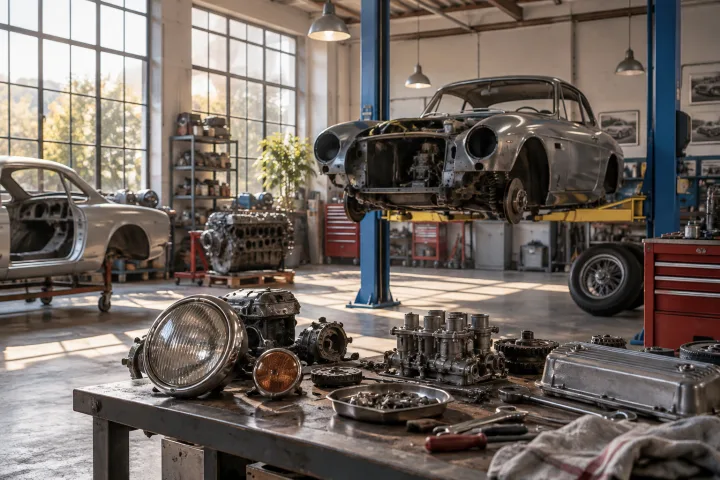
The value of a classic car depends not only on its mechanical condition but on its documented history. To increase the appraisal and buyer confidence, it is essential to gather the original purchase invoice, registration history, maintenance book, and user manual.
In Spain, the new Historic Vehicles Regulation, in force since October 2024, establishes that a vehicle can be considered historic if it has at least 30 years of age. Group A vehicles (over 30 years old) can be classified through a responsible declaration, limiting their use to 96 days per year.
Vehicles over 60 years old are exempt from periodic MOT (ITV), although they can undergo it voluntarily. Verifying if the car meets these requirements is key to understanding its legality and future maintenance costs.
Section references: Zalba-Caldú: Cómo documentar la historia de tu coche clásico ↗ · RACE: Reglamento de Vehículos Históricos ↗
- Key Documentation: Original invoice, registration history, maintenance book.
- Historic Regulation: Minimum 30 years of age.
- MOT: Periodic exemption for vehicles over 60 years old.
Risks and Legal Procedures in Spain
Buying a car at auction involves specific risks. In judicial auctions, if the asset comes from a natural person, the transaction is subject to the Property Transfer Tax (ITP), whose rate varies between 4% and 8% depending on the autonomous community.
After the purchase, the buyer is obligated to change the ownership at the DGT within a maximum of 30 days. To do so, it is required to be in good administrative standing, have paid the previous year's Circulation Tax, and have paid any possible fines.
Before the transfer, the payment or exemption of the ITP must be justified via form 620 or 621. Ignoring these deadlines can result in fines and the inability to legalize the vehicle.
Section references: DGT: Transferencia o cambio de titularidad de un vehículo ↗ · Diario de Subastas: Comprar un coche clásico ↗
- ITP: 4% - 8% depending on autonomous community (judicial auctions).
- DGT Deadline: 30 days for ownership change.
- Requirements: Administrative standing, circulation tax paid, and no fines.
Can I withdraw my bid if I change my mind in an online auction?
No, bids are binding. If you win the auction and back out, you may have to pay the full service fees, which on platforms like Benzin amount to 7.8% (VAT included) with a minimum of €398.
What taxes do I have to pay if I buy a classic car at a judicial auction?
If the vehicle comes from a natural person, you must pay the Property Transfer Tax (ITP), which ranges between 4% and 8% depending on the autonomous community where you register it.
How often do I have to pass the MOT if my car is over 60 years old?
Vehicles over 60 years old are exempt from the mandatory periodic MOT, although you can undergo it voluntarily if you wish.