What to Check Before Your First Boat Trip
A safe first trip starts before you leave the dock: check official conditions, know the vessel’s limits, and agree on its range, equipment and return plan.
Key points
Before setting out by boat, check the forecast for your area and schedule, the vessel’s limits, required safety equipment and expected range. Agree on the plan and return time with the skipper, and leave the trip details with someone ashore.
Before setting out: four key checks
For your first boat trip, check four things before leaving the harbor: that the forecast suits the trip, that the vessel and area allow for the plan, that the applicable safety equipment is on board, and that there is enough range to return with a margin. If you are a passenger or are renting with a skipper, ask them to explain the plan and its limits; a generic checklist is not a substitute for their judgment or nautical training.
Section references: Navegación de recreo: lista de comprobación ↗ · Checklist antes de zarpar en barco: 10 minutos ↗
- Forecast and alerts for the planned area and schedule.
- The vessel’s characteristics, condition and limits, and the navigation area.
- Equipment appropriate for the vessel, area and people on board.
- Range, return time and someone ashore who knows the plan.

Check the weather for the entire trip
Check the weather forecast before setting out and make sure it covers the full planned schedule, not just the time of departure. Salvamento Marítimo includes weather among its pre-departure checks; GP Náutica recommends checking an up-to-date forecast for the entire trip.
If the skipper or rental company considers conditions unsuitable, follow their advice and postpone or cancel. Favorable conditions at the start do not guarantee that the plan will remain suitable for the return journey.
Section references: Navegación de recreo: lista de comprobación ↗ · Checklist antes de zarpar en barco: 10 minutos ↗

Confirm the vessel and area limits
Before agreeing to the itinerary, find out what vessel you will be on, where it is permitted to navigate and what the plan is. The navigation area affects which safety equipment must be carried, so a generic list or simply knowing that the boat has life jackets is not enough.
If you are renting, ask what equipment is included, what checks the skipper performs and what conditions could change the trip. As a passenger, raise any concerns before setting out. Salvamento Marítimo’s checklist also covers checking navigation and steering equipment; technical checks on a specific boat are the responsibility of the person in command who knows the vessel.
Section references: Navegación de recreo: lista de comprobación ↗ · Lista de comprobación antes de salir a navegar en barco o velero ↗
- Ask what route and schedule are planned.
- Confirm that the required equipment for the area is on board and in usable condition.
- Clarify who decides whether to postpone, change or end the trip.
Check the applicable safety equipment
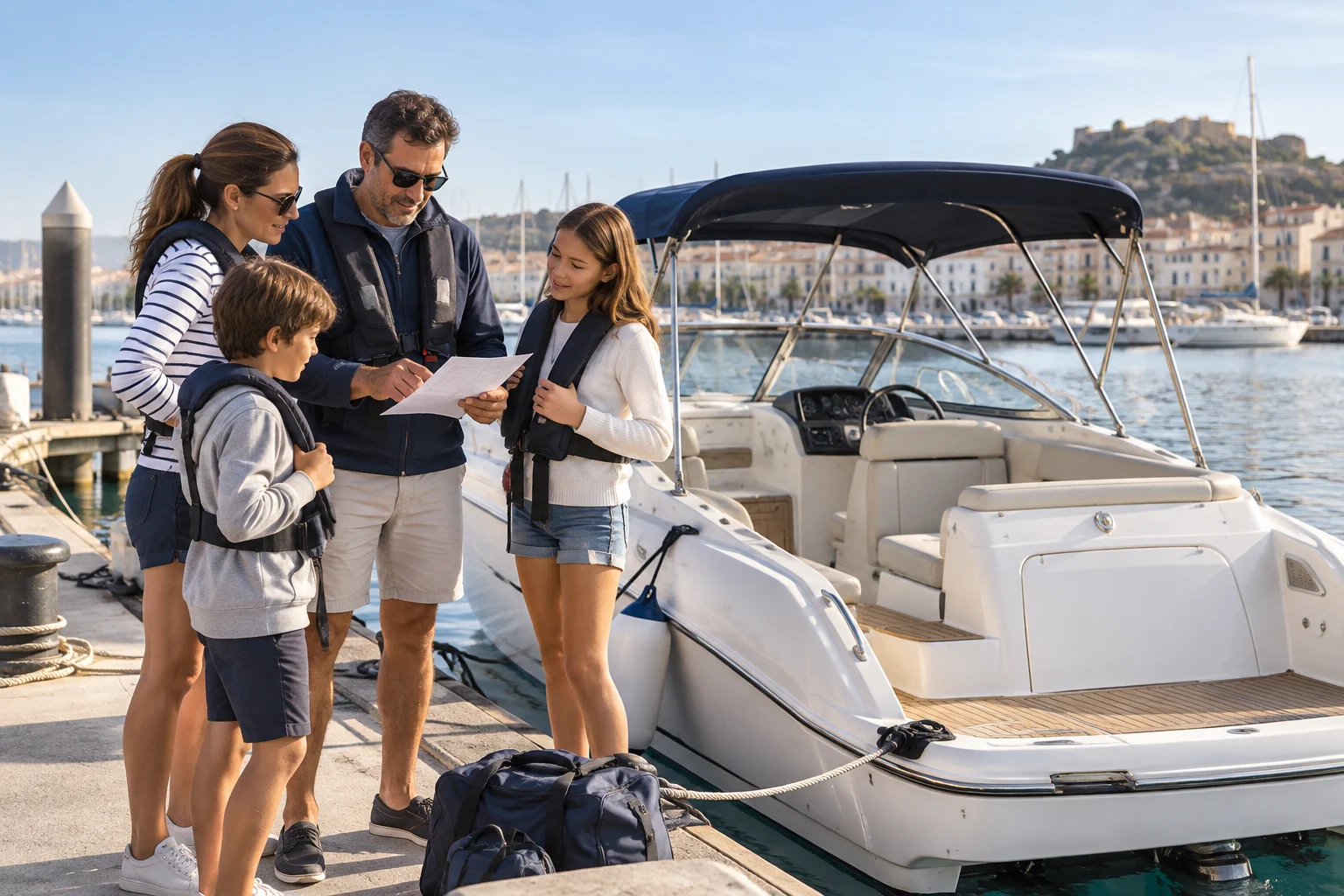
Confirm with the skipper or rental company that there are life jackets for everyone on board and that the safety equipment is appropriate for the area and vessel. Requirements can vary: the sources mention items such as flares, fire extinguishers, a life raft or lifebuoys, depending on the circumstances. Do not use an online checklist to determine exact legal requirements; confirm what applies to that vessel and trip with the person in charge and under the relevant regulations.
Make sure you also know where the life jackets are and how to receive the skipper’s instructions. If nobody has explained the basic equipment or something the person in charge considers necessary is missing, resolve the issue before departure.
Section references: Checklist antes de zarpar en barco: 10 minutos ↗ · Lista de comprobación antes de salir a navegar en barco o velero ↗
- Include everyone on board, including children, when checking the number of life jackets.
- Ask where the safety equipment is stored and whether it is within its validity period where applicable.
- Follow the skipper’s instructions on using the equipment.
Estimate range and agree on the return
Plan for the intended route and a margin for the return; do not calculate consumption only as far as the destination. On a motorboat, the person in charge should confirm that the available fuel covers the plan with a margin. GP Náutica’s suggestion to use no more than two-thirds of usable diesel is that source’s recommendation, not a universal rule for every vessel. On an electric boat, agree with the skipper on how the energy available for the route has been assessed.
Before leaving, agree on the expected duration, return time and what to do if conditions or the plan change. Do not extend the trip on your own or assume the fuel or charge will be sufficient without confirmation from the person at the helm.
Section references: Checklist antes de zarpar en barco: 10 minutos ↗ · ¿Qué hacer antes de zarpar? Hablamos con un skipper ↗
- Ask the skipper to confirm the planned range for the route, including a return margin.
- Find out the agreed latest return time.
- Confirm with the skipper what to do if departure is delayed or the route changes.
Share the plan and postpone if in doubt
Tell someone ashore your intended destination or route, approximate return time and how many people are on board. GP Náutica recommends informing someone ashore of the navigation plan; if it changes significantly, the skipper should decide how to update them.
Postpone or cancel if the forecast does not suit the trip, the skipper cannot confirm that the vessel and equipment are appropriate, the range does not provide a clear margin for the return, or essential details of the plan are missing. On a first trip, do not improvise to make up for uncertainty: check with the skipper or rental company before setting out.
Section references: Navegación de recreo: lista de comprobación ↗ · Checklist antes de zarpar en barco: 10 minutos ↗
- Leave someone ashore the itinerary, return time and number of people on board.
- Make sure they know whom to contact if you do not confirm your return as planned.
- Do not set out if a significant concern remains about conditions, equipment or range.
What should I check before my first boat trip?
Check the forecast for the whole trip, the plan and limits of the vessel and navigation area, the applicable safety equipment, and the range with a margin for the return. Make sure someone ashore knows the itinerary and expected return time.
Can a generic checklist tell me what equipment is required?
Not by itself. Equipment requirements depend, among other things, on the vessel and navigation area. Confirm with the skipper or rental company what is needed for that trip.
What information should I leave with someone ashore?
The intended destination or route, approximate return time and number of people on board. Also agree on what to do if you do not confirm your return as planned.