How to Check Whether a Van Fits in a Car Park
The catalogue height may not reflect a van that is fully equipped and ready for work. Find out what to measure and what to check in garages, car parks and loading bays before choosing or assigning a vehicle.
Key points
To check whether a van will fit, compare the clearance at every access point with the vehicle’s full height in its intended working configuration, including equipment, accessories and planned load. Check ramps, doors and overhead obstacles too, and allow a prudent margin rather than relying on a catalogue figure.
Which van height should you compare?
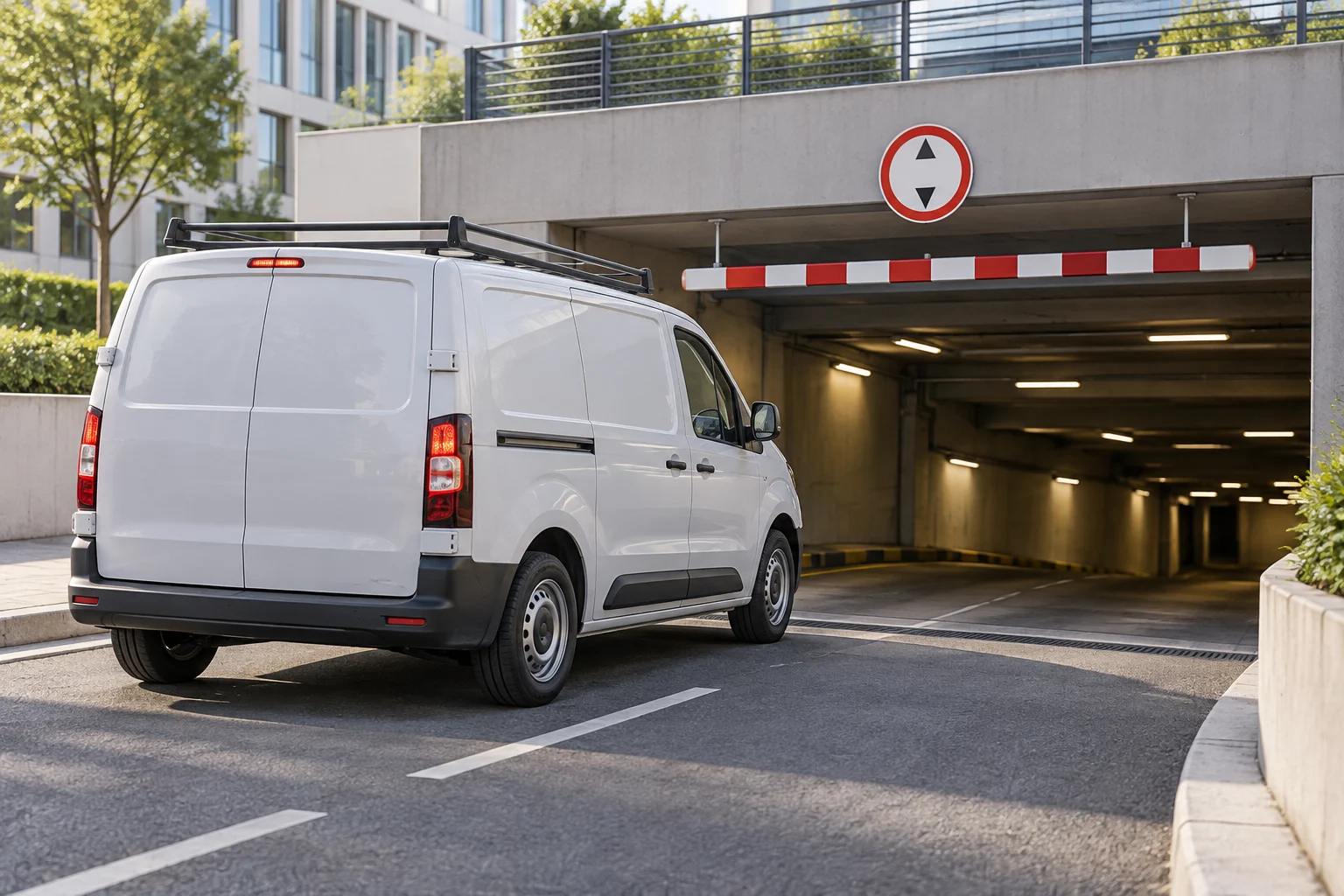
Compare the clearance at the entrance with the vehicle’s total height in the exact configuration in which it will be driven. The body height alone is not enough: include anything that protrudes above the roof, such as an antenna, roof rack, bicycle carrier or roof box. Include any conversion or permanently fitted equipment too.
The height displayed at a car park entrance does not guarantee that the entire route has the same usable clearance. Inside, pipes, lights or hanging ducts may be lower; in a garage, the overhead door and changes in the slope of a ramp can also restrict access.
Section references: Altura y gálibo de una furgoneta de alquiler ↗
- Record the total height of the equipped vehicle, not just the model’s general specifications.
- Check every critical point along the route: entrance, door, ramps, turns and loading area.
- If the access is controlled by someone else, confirm the conditions with the operator or site manager.

Why the catalogue figure may be too low
Height varies by model and version, and modifications can change it. Items that may raise the highest point include solar panels, roof vents and roof racks fitted with non-original mounts. Panelling and insulation can also affect the dimensions of a converted camper van.
Vehicle weight and tyre pressure affect the measured height. Check the specific vehicle and, where possible, reproduce its working configuration: accessories fitted and a load similar to what it normally carries. For a rental van, confirm the height of the actual vehicle in its documentation or on the door label rather than assuming every version is the same.
Section references: Cómo medir la altura para homologar una camper ↗ · Altura y gálibo de una furgoneta de alquiler ↗
- Include permanently fitted equipment and removable accessories that will be carried on the roof.
- Allow for the planned load and check that the tyres are at the correct pressure.
- For converted vehicles, confirm the modifications and dimensions with the converter.

How to measure the vehicle and check your usual route
To measure the total height, find the highest point and measure vertically down to the ground. On level ground, you can rest a straight batten horizontally on that point and measure from the batten to the ground. Measure the vehicle in the configuration in which it will be used; for example, an empty roof rack and a loaded one should not be treated as the same configuration if anything protrudes above it. Do not climb onto the roof or measure in a way that risks a fall. If you cannot measure safely from the ground, ask a professional to do it.
Then compare that measurement with the access points the van will actually use. Check ramps and doors, and do not rely only on the sign outside: overhead obstacles may reduce the clearance inside. If you are unsure about private access or a loading bay, ask the person responsible to confirm the clearance at its most restrictive point.
Section references: Cómo medir la altura para homologar una camper ↗ · Altura y gálibo de una furgoneta de alquiler ↗
- Measure on level ground from the highest item to the ground.
- Record the vehicle’s height separately without accessories and in its working configuration, if both configurations are used.
- Check the full route through the usual access points; a high entrance does not rule out a lower obstacle inside.
Allow a margin and confirm the configuration before deciding
There is no universal margin that works for every van and access point. Measurements can vary with tyre pressure or vehicle weight, and the advertised clearance may not reflect the lowest point along the entire route. Do not choose a vehicle whose measured height exactly matches the sign: allow enough room for these variations and check the critical points.
Before buying, assigning or renting a van, confirm the height of the specific version and equipped vehicle. If it has been converted, ask the manufacturer or converter for its final height; if the access is at a car park or loading bay, check the effective clearance with the operator. If you cannot verify the most restrictive point or cannot ensure an adequate margin, choose a different configuration or route.
Section references: Cómo medir la altura para homologar una camper ↗ · Altura y gálibo de una furgoneta de alquiler ↗
- Ask for the final height of the specific vehicle with its accessories fitted.
- Check what load and tyre pressure were taken into account when it was measured.
- Verify the lowest point along the access route; consider another vehicle if you cannot ensure an adequate margin.
Can the catalogue height tell me whether a van will fit?
It is a useful reference, but it may not reflect the specific version, accessories, a conversion or the load. Confirm the height of the vehicle in the configuration in which it will be used.
Do I need to include a roof rack or roof box?
Yes. Compare the access clearance with the highest point of the equipped van, including anything that protrudes above the roof.
Is it enough to check the sign at the car park entrance?
Not always. There may be lower pipes, lights or ducts inside, as well as overhead doors or ramps that reduce usable clearance.