Off-Grid Campervan Electricity: How to Plan Your Usage
List your appliances, estimate their consumption in Wh, and compare it with usable battery capacity and your charging options. This helps you prioritise usage and review your power balance during the trip.
Key points
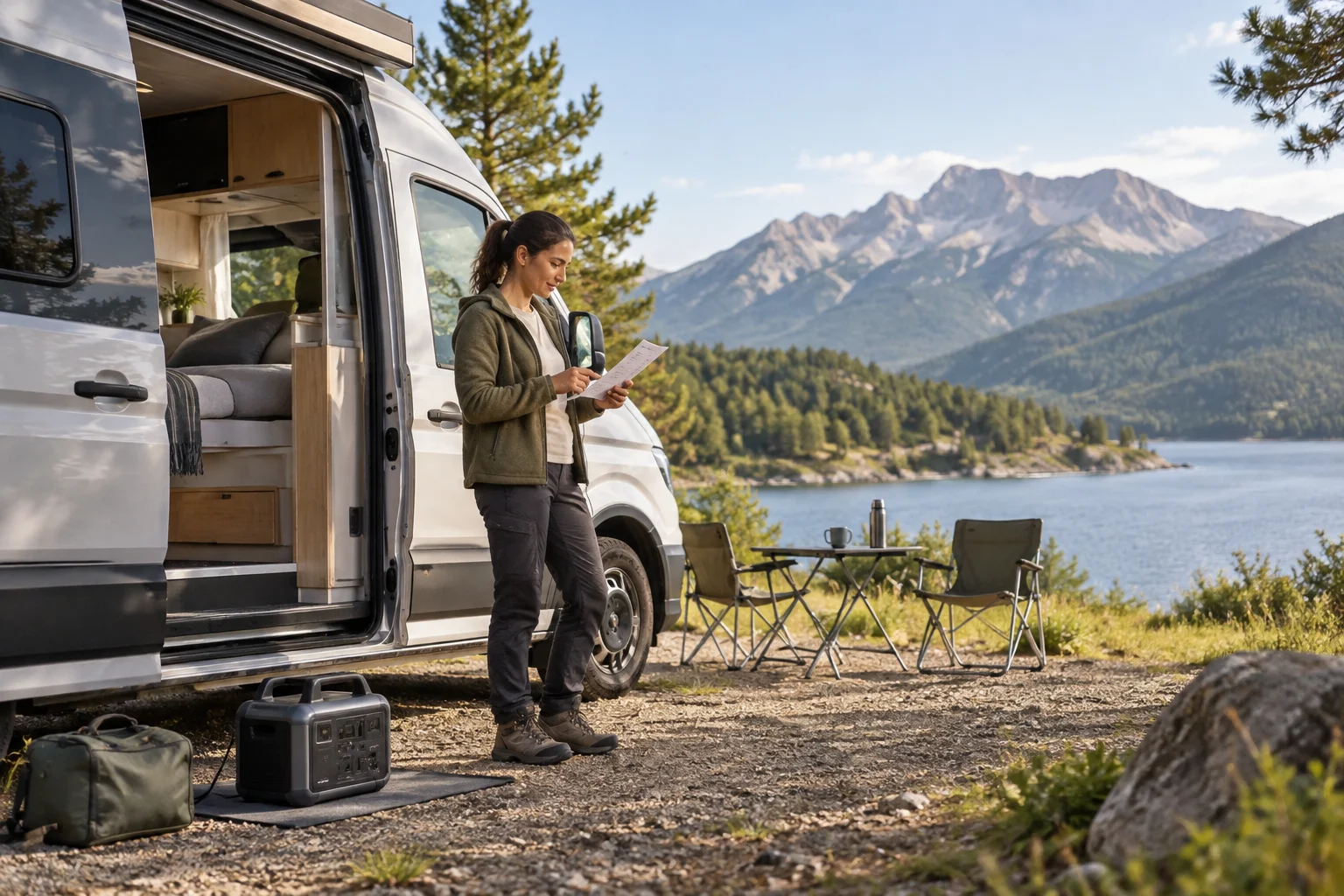
To manage electricity in an off-grid campervan, estimate your appliances’ daily consumption and compare it with the usable capacity of the leisure battery and planned recharging. Adjust your plan to actual use and travel conditions.
Start with your consumption and usable energy
There is no universal figure for how many days a campervan can run off-grid. It depends on the appliances, how long they are used, the usable capacity of the leisure battery and the energy replenished during the trip. To plan, first work out a daily budget in watt-hours (Wh) and compare it with the latter two figures.
This estimate helps you compare scenarios; it cannot guarantee an exact runtime. If you do not know the battery’s usable capacity or your system’s charging limits, check the manufacturer’s documentation or consult a professional before making decisions about the installation. You can also read our guide to auxiliary batteries for campervans.
Section references: Cómo planificar la instalación eléctrica de tu camper 2026 ↗

List your appliances and estimate daily Wh consumption
Write down each appliance, its power in watts and its expected daily usage in hours. The basic formula is power (W) × hours of use = consumption (Wh). For example, an appliance rated at 20 W and used for 3 hours consumes an estimated 60 Wh.
For appliances that run intermittently, the time they are switched on is not always the same as their continuous running time. A fridge may run its compressor only part of the time, and its actual consumption can vary with conditions. Use the manufacturer’s consumption figure if available, and note actual usage during your trip to refine your budget.
Add up the estimated consumption and separate essential appliances from those you can reduce or postpone. You can connect a 12 V appliance directly only if both the appliance and the installation are compatible. For appliances powered through an inverter, remember that conversion uses energy; one source suggests adding 15% as a rough estimate, not a universal efficiency figure.
| Appliance | Power (W) | Expected use (h/day) | Estimated consumption (Wh/day) |
|---|---|---|---|
| Appliance 1 | Appliance rating | Expected hours | Power × hours |
| Appliance 2 | Appliance rating | Expected hours | Power × hours |
| Daily total | — | — | Sum of consumption |
Section references: Cómo calcular el consumo eléctrico de tu camper sin quedarte sin batería ↗ · Cómo planificar la instalación eléctrica de tu camper 2026 ↗
- Note each appliance, its rated power in W and its expected hours of use.
- Distinguish continuous from intermittent operation, and use manufacturer data when available.
- Calculate each appliance’s daily Wh consumption and add the figures together.
- Identify priority uses and those you can limit or postpone.

Distinguish the starter battery from the leisure battery
The starter battery and the auxiliary or leisure battery serve different purposes. To estimate how long your appliances can run, identify which battery powers them; do not assume that its entire nominal capacity is available for your intended use.
Usable energy depends on the battery technology and the manufacturer’s recommendations. As a published general guide, one source gives a recommended depth of discharge of 50% for AGM or gel batteries and 80–90% for LiFePO4 batteries. These are general reference points, not values to apply automatically to every battery. Check the documentation for the battery installed in your vehicle and compare its usable capacity with your total daily consumption in Wh.
Section references: Cómo calcular el consumo eléctrico de tu camper sin quedarte sin batería ↗
Plan recharging without assuming a fixed output
Identify the charging sources available in your campervan: charging while driving, solar panels and an external power connection, if fitted. Note when you might use each one in your itinerary, but do not subtract their output from your consumption as if they always supplied a fixed amount.
Solar output changes with generating conditions. One source cites an average equivalent of four or five hours of full solar production per day in Spain. This is a general reference, not a forecast for every season, location, panel or installation. A panel’s rated power alone also does not tell you how much energy will reach the battery.
Charging while driving also depends on the installed system. Do not convert a charger’s amp rating directly into a guaranteed amount of stored energy: assessing the actual contribution requires information about the installation and charging conditions. When using an external hookup at a campsite or stop, check that the supply and the campervan’s system are compatible.
Section references: Cómo calcular el consumo eléctrico de tu camper sin quedarte sin batería ↗ · Guía de instalación eléctrica para una furgoneta camper ↗
- Note which charging sources the vehicle has and when they will be available during the trip.
- Treat solar figures as conditional references, not guaranteed output.
- Check the installation documentation for its limits and charging method.
Prioritise consumption and review your power balance during the trip
If your expected consumption is close to the usable battery capacity, prioritise essentials, reduce the time you use non-essential appliances and plan to recharge before relying on an uncertain energy supply. The useful comparison is between your daily budget, the energy you can draw from the battery and the recharging you realistically expect to do.
At the end of each day, note which appliances you used and what recharging took place. If actual consumption exceeds your estimate or planned recharging did not happen, adjust the next day’s plan. This keeps your estimate aligned with your habits and the trip, rather than relying on a generic autonomy figure.
Section references: Cómo planificar la instalación eléctrica de tu camper 2026 ↗
When to have the electrical installation checked
If you do not know the battery’s usable capacity, appliance compatibility or charging limits, check the manufacturer’s documentation or ask a professional to inspect the system. Do not improvise connections or assume maximum ratings: the specific installation determines which components are compatible and how they should be used.
Before seeking advice, gather the leisure battery’s type and specifications, the appliances’ power or consumption figures, the charging sources and any available information about protective devices and connections. In Spain, a specialist source states that an authorised installer must sign the electrical certificate required to legalise campervan installations. Ask a professional to confirm which documents apply to your vehicle and the specific modification.
Section references: Instalación eléctrica en furgoneta camper ↗
- Specifications and documentation for the leisure battery.
- Appliance power or consumption figures and connection method.
- Charging sources and available information about installed protective devices.
- Photos of components or their labels, if requested by the professional.
How do I calculate an appliance’s daily consumption in a campervan?
Multiply its power in watts by the expected hours of use per day. The result is an estimate in Wh; for intermittent appliances, the time switched on may not equal the time actually running.
Can I use all of a battery’s rated capacity?
Not necessarily. Usable capacity depends on the battery technology and the recommendations for that specific battery. Check its documentation before calculating the energy available.
Can I count on the same amount of solar energy every day?
No. Output varies with generating conditions and the installation. An average figure is a reference, not a guarantee of daily production.