How to Verify Child Car Seat Compatibility with the DGT Interactive Guide
A practical guide to checking your child car seat's compatibility with your car using the official DGT tool, R129 regulations, and the harness pinch test.

Key points
Verify your child car seat's R129 homologation on the orange label, confirm vehicle compatibility using the DGT interactive guide, and apply the pinch test to ensure the harness is secure before every trip.
Initial verification: regulations and homologation label
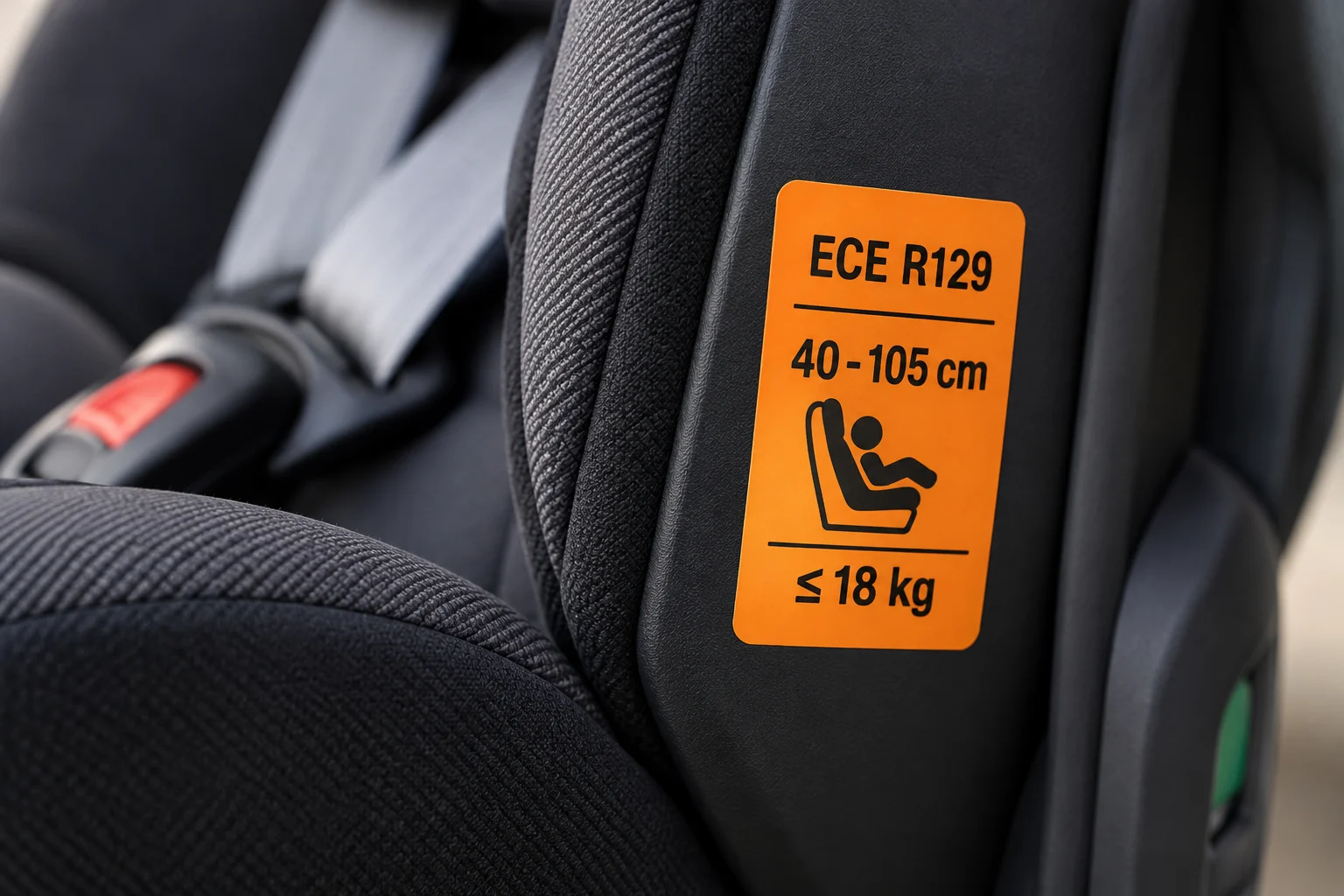
Before using the DGT interactive tool, it is essential to identify the regulation under which the child restraint system is homologated. Since September 2023, the manufacture of seats under the R44 regulation has been prohibited in Europe, and since September 1, 2024, their sale has also been banned in the European Union. However, R44 seats already sold remain valid and safe for use, although the R129 regulation offers more up-to-date safety criteria.
To distinguish between the two, you must read the orange label attached to the product. The R129 regulation classifies seats by the child's height (size) rather than by weight or age, and requires keeping the child rear-facing until at least 15 months of age. This information is the first data point you must enter or verify when cross-checking the official guide.
Section references: SRI: cambio de norma ↗
- Locate the orange label on the seat to identify whether it is R44 or R129.
- If it is R129, verify that the size corresponds to the child's current height.
- Remember that older R44 seats remain legal if they are in good condition.
Using the DGT interactive guide
The DGT offers an interactive tool on its official website to help drivers verify compatibility between their vehicle and the child restraint system. This resource allows you to enter the characteristics of the car and the seat to obtain an installation recommendation. It is important not to assume compatibility based solely on the brand or model, but on the specific technical data requested by the tool.
When using the guide, you must accurately record the characteristics of the car's anchor points (such as the presence of ISOFIX or top tether points) and the seat's data. This verification is an essential complement to reading the manufacturer's manual, as regulations require that the installation be appropriate for the specific vehicle.
Section references:
- Access the official tool on the DGT website.
- Enter the car and seat data exactly as they appear in their manuals.
- Do not assume compatibility without confirmation from the tool or the manufacturer.

The pinch test and installation safety
Once compatibility is verified, the physical installation must undergo fit tests. The 'pinch test' is a practical technique recommended to check harness tension. It involves buckling the child (removing bulky coats) and attempting to pinch the harness webbing with your fingers. If you can pinch it and a fold remains, the harness is too loose and must be tightened until there is no slack.
Driving with a child without an appropriate or properly installed restraint system is considered a serious offense under the General Traffic Regulation. The fine can reach 200 euros, reduced to 100 euros if paid within the following 20 days. Therefore, verification is not just a safety recommendation but a legal obligation.
Section references: Revisa la silla infantil del coche con el test de la pinza antes de la vuelta al cole ↗
- Remove bulky clothing before buckling the harness.
- Apply the pinch test: if you can pinch the webbing, tighten the harness.
- Check the seat's stability: it should not move more than 2.5 cm at the base.
Can I still use my R44 seat if it is no longer sold?
Yes, R44 seats already sold remain valid and safe for use, although the R129 regulation is more up-to-date. You must ensure the seat is in good condition and correctly installed.
What happens if the seat harness is loose?
If you can pinch the harness webbing with your fingers, it is too loose. You must tighten it until there is no slack. Driving with a poorly installed seat is a serious offense punishable by up to 200 euros.
Does the DGT interactive guide replace the manufacturer's manual?
No, it is a complement. You must follow the manufacturer's instructions for installation, but using the DGT guide helps you verify the specific compatibility between your car and the seat.