Electric Scooter for Commuting: What to Compare
The advertised range does not guarantee that a scooter will cover your route. Learn how to compare your real journey, weight, comfort, braking and battery support before you buy.
Key points
To choose an electric scooter for commuting, map your full journey and consider where you will charge it. Then compare range with a safety margin, weight and folding, tyres, suspension, brakes, lighting and replacement-battery availability.
Start with the whole journey, not the scooter’s spec sheet
To choose an electric scooter for commuting, calculate your total return distance and consider the conditions you will actually encounter: hills, uneven surfaces, stops and changes of pace. If your route varies from day to day, use the most demanding of your regular journeys as your benchmark, not just the shortest route.
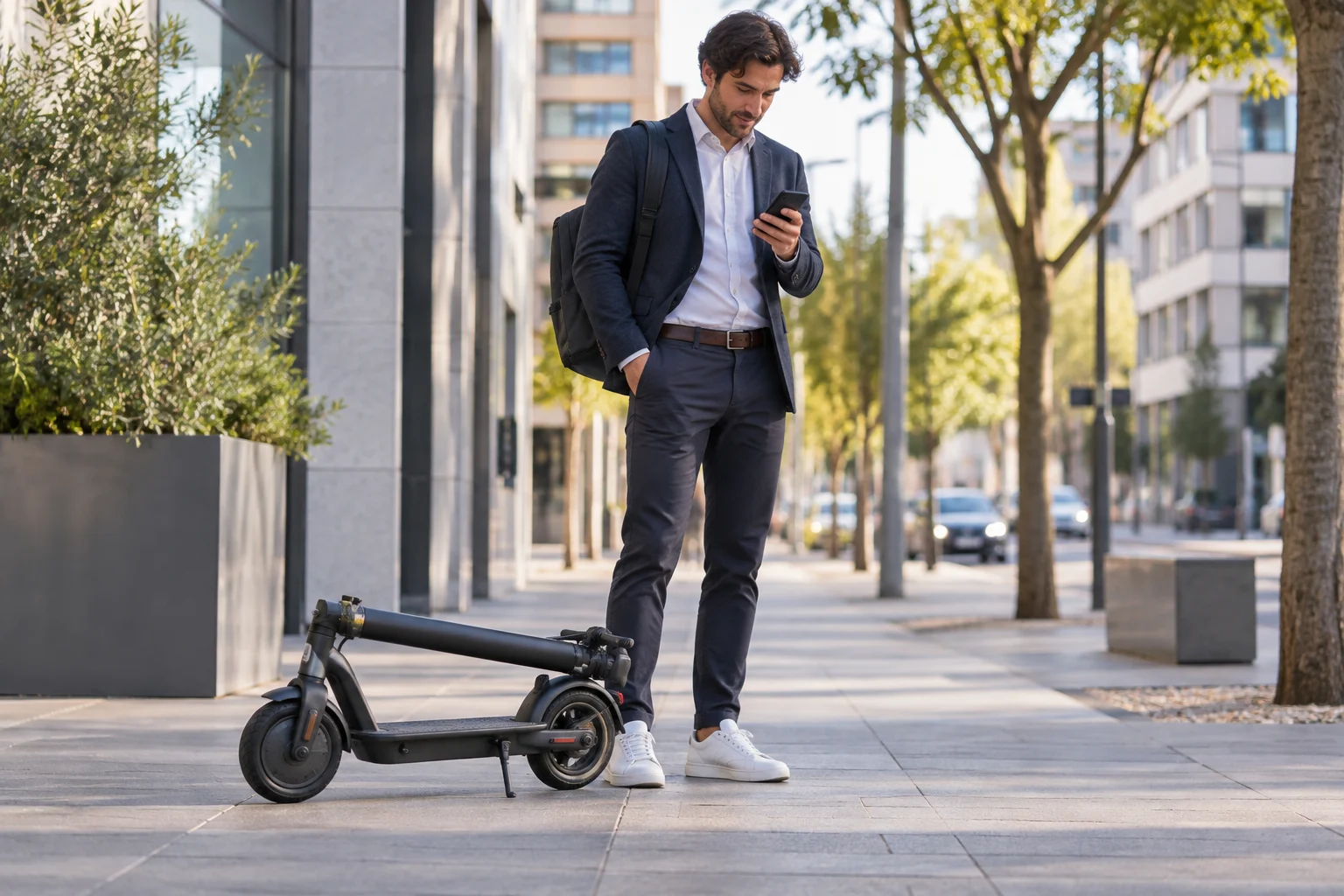
Also note where you will store and charge the scooter, and whether you will need to carry it upstairs or combine it with public transport. These details can make a longer-range model less practical than a lighter scooter that folds easily. Explore other options for light mobility.
- Total daily distance and possible detours.
- Gradients, surface conditions and how often you stop.
- Sections where you will need to carry the scooter, and available storage space.
Range: compare with a margin, not as a promise
Published range figures usually reflect favourable conditions and do not guarantee how far a scooter will travel for every rider. Range can vary with the route, gradients, rider weight, riding style and weather; speed, tyre pressure and temperature also matter. Real journeys involve acceleration, braking and changes of pace that can make actual range differ from the advertised figure.
When comparing models, use the stated range as a guide for ruling out options that are clearly unsuitable for your journey, not as a distance you are certain to cover. Allow a margin for your usual conditions, and do not assume that a larger battery will deliver a proportionate increase in kilometres.
Multiplying voltage by amp-hours gives an approximate battery energy capacity in watt-hours (Wh). This is useful for comparing batteries, but it does not determine range on its own: the motor, electronics, weight and overall efficiency also matter.
Section references: Cómo elegir un patinete eléctrico: características y consejos ↗ · Qué mirar antes de comprar un patinete eléctrico homologado ↗
- Check whether the range figures were measured under comparable test conditions.
- Consider the most demanding route you travel regularly.
- Treat Wh as a measure of energy capacity, not as a guaranteed distance.
Weight and folding: consider every time you move it
Weight matters especially if you need to carry the scooter, store it at home or combine it with other forms of transport. RACE describes models under 10 kg as very light and practical to carry by hand; carrying models in the 20–30 kg range is considerably more demanding. These are general guide figures, so check the exact model’s weight and how often you will need to lift it.
Check how the scooter folds and whether it is easy to manoeuvre when folded. Do not rely on the word “foldable” alone: consider how much space it takes up and whether the folded size suits your storage space.
Section references: Cómo elegir un patinete eléctrico: características y consejos ↗
- If you face stairs or transfers, prioritise a weight you can comfortably manage.
- If you will rarely carry it, you can give other aspects of your journey more weight.
- Compare the folded dimensions with your actual storage space.
Tyres and suspension: comfort versus maintenance
Pneumatic tyres provide a more comfortable ride; solid tyres require less maintenance but transmit more vibration. The right choice depends on your route’s surfaces and how you balance reduced maintenance against a less bumpy ride.
Suspension may be front, rear or both. Check the configuration on each model and consider how useful it will be on the uneven sections of your route. Do not compare suspension by its mere presence: relate it to the surfaces you travel on every day.
| Feature | Potential advantage | Trade-off |
|---|---|---|
| Pneumatic tyres | A more comfortable ride | Consider the maintenance the model requires |
| Solid tyres | Less maintenance | Transmit more vibration |
| Low weight | Easier to carry by hand | Check that the model also suits your route |
| Suspension | May help the scooter handle uneven surfaces | Compare whether it is front, rear or both |
Section references: Cómo elegir un patinete eléctrico: características y consejos ↗
- On uneven surfaces, consider how the tyres and suspension affect vibration.
- If you prioritise lower maintenance, bear in mind that solid tyres transmit more vibration.
- Compare the specific suspension setup on each model.
Brakes, lights and water: check the model’s equipment
Compare the braking systems on each scooter and check the manufacturer’s specifications to see what the particular model includes. Do the same for lighting and visibility: check which lights are fitted and whether they suit the conditions in which you usually travel. Do not assume all models have the same equipment.
If your route includes rain or wet surfaces, check the model’s stated water resistance and the conditions it covers. Do not interpret that rating as permission to submerge the scooter or as a guarantee that it can be used in every situation.
- Compare the braking equipment and lighting listed for each model.
- Look up the water-resistance specification and its conditions of use.
- Read the warranty for the model, especially the terms covering the battery and electrical components.
Battery, servicing and final checks
Before deciding, check whether the manufacturer or distributor offers a compatible replacement battery and whether a service centre can install or repair it properly. Availability of replacement parts and support can matter just as much as battery capacity for continued use.
When comparing two models, separate verifiable specifications from your personal priorities. The specifications help identify differences; your route, transport arrangements and charging location determine which differences matter most.
Section references: Qué mirar antes de comprar un patinete eléctrico homologado ↗
- Does the advertised range leave a margin for your usual journey?
- Can you carry, fold and store the scooter easily?
- Do the tyres and suspension suit the surfaces on your route?
- Have you compared the brakes, lights and water-resistance rating?
- Are compatible replacement batteries, servicing and clear warranty terms available?
- Have you checked the rules that apply to your journey in Spain? Choosing a model and understanding the rules of the road are separate matters; check the current information for your circumstances.
Is the advertised range the distance I will travel each day?
Not necessarily. It is usually measured in favourable conditions and can vary with the route, gradients, rider weight, riding style, temperature and other factors. Treat it as a guide and consider the most demanding journey you make regularly.
Does a battery with more Wh guarantee more kilometres?
No. Wh indicates approximate energy capacity, but range also depends on the motor, electronics, weight and overall efficiency.
Which type of tyre is best for commuting?
Pneumatic tyres provide a more comfortable ride; solid tyres require less maintenance but transmit more vibration. The choice depends on the surfaces you travel on and your priorities.
What should I check if I need to carry the scooter?
Check its exact weight, folded size and whether you can manage it on the sections where you will carry it. A lighter model may be more practical if you encounter stairs or transfers.