Cabin Filter: When to Change It and What to Check
Check Repsol's general guidance and ensure your quote specifically identifies the cabin filter and the work included.
Key points
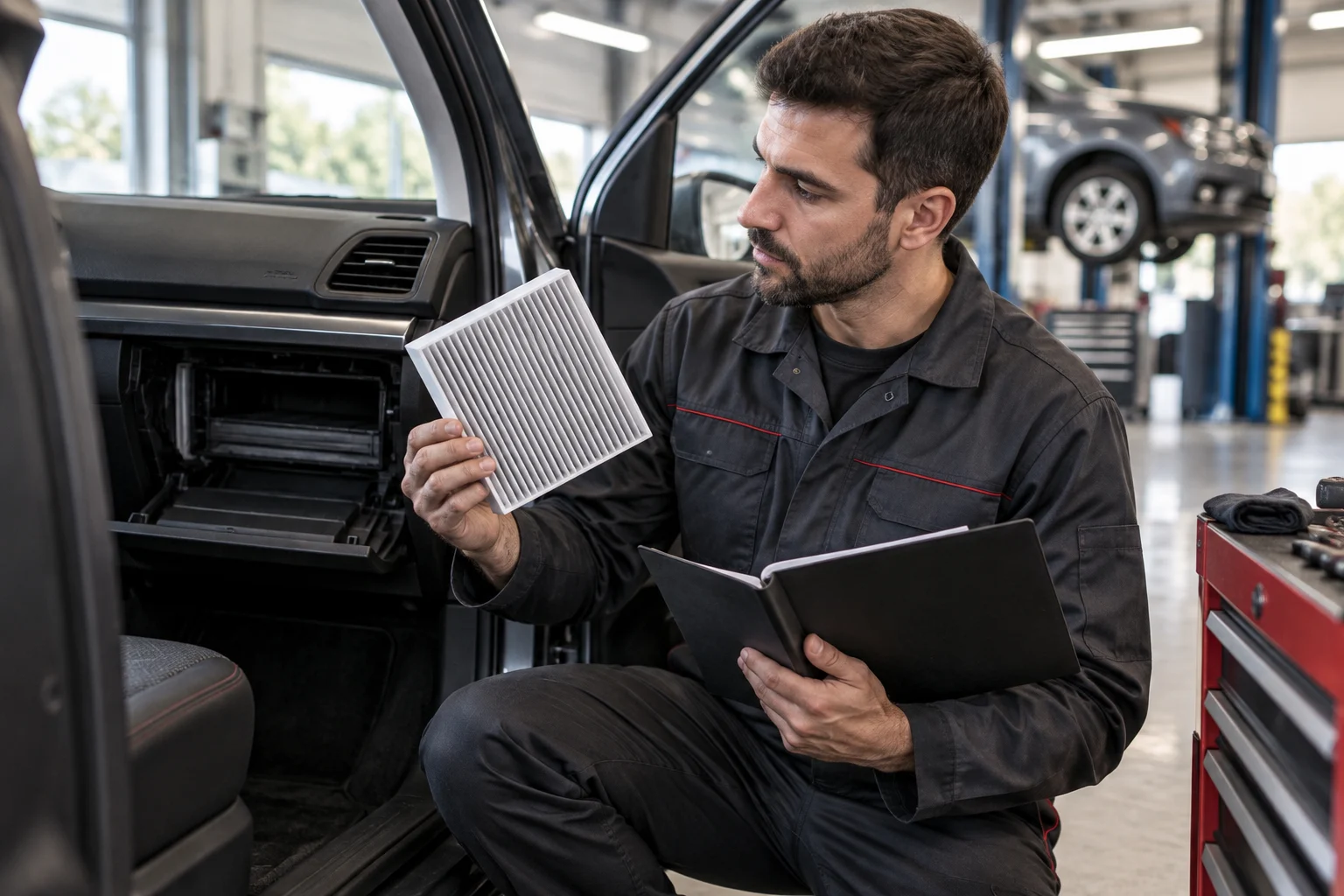
Repsol provides general guidance for changing the cabin filter, but does not confirm a universal rule or that a specific car needs replacement. This article explains how to use that reference and what to clarify if a quote only mentions an 'air filter'.
Repsol's general guidance
Repsol suggests changing the cabin filter every 15,000–20,000 km or once a year as a general guideline. This is a general reference from that source, not a confirmed rule for all vehicles.
If you keep records of the last change, have the mileage and date ready.
Section references: Filtro de habitáculo: para qué sirve y cuándo cambiarlo ↗
How to use that reference in your case
Note the date and mileage of the last change, if you have that data, and compare it with Repsol's guidance. The figure can serve as context for talking to the workshop, but it does not confirm on its own that your car's filter needs replacing.
Weaker airflow, frequent window fogging, or seemingly less effective climate control can be reasons to check the filter; none of these signs confirm on their own that it is saturated.
If you don't have records or notice any of these signs, tell the workshop and ask them to explain the basis for their recommendation.
Section references: Filtro de habitáculo: para qué sirve y cuándo cambiarlo ↗ · ¿Con qué frecuencia se debe cambiar el filtro de habitáculo? ↗

Cabin filter or engine air filter: what available information confirms
If the quote only says 'air filter', do not assume which one it refers to. The cited Repsol information deals with the cabin filter, but it does not allow identifying which part is included under a generic quote description.
RACE describes the engine air filter as necessary to ensure impurity-free air reaches the engine. This description helps identify the function mentioned by the source, but it does not reveal which part a generic quote proposes to replace.
Ask the workshop to specify which filter they propose to replace and confirm that the replacement part corresponds to your car.
| Situation | What available information indicates | What it does not allow concluding | What to confirm with the workshop |
|---|---|---|---|
| Cabin filter | Repsol offers a general guideline to change every 15,000–20,000 km or once a year. | The guideline does not confirm a universal rule or that a specific car's filter needs replacing. | That the quoted part and work correspond to the cabin filter. |
| Engine air filter | RACE indicates it is necessary for impurity-free air to reach the engine. | This description does not identify which filter a quote simply saying 'air filter' includes. | Which filter the quote refers to and if the part corresponds to the car. |
Section references: Filtro de habitáculo: para qué sirve y cuándo cambiarlo ↗ · Cuándo cambiar el filtro de aire del coche ↗
What replacement to request and what the quote must identify
Ensure the quote identifies the cabin filter and distinguishes the part from the proposed work. If only 'air filter' appears, ask the workshop to clarify which one it refers to and confirm the part fits your car.
When picking up the car, check that the invoice identifies which filter was replaced and keep the document.
In summary
Repsol's guidance serves as a general reference, not as confirmation that your car's filter must be changed. If the quote does not specify which filter is included, ask them to identify it before authorizing the work.
Section references: Filtro de habitáculo: para qué sirve y cuándo cambiarlo ↗
Does Repsol's guidance apply to any car?
It should not be taken as a universal rule. Repsol offers that figure as a general guideline, which on its own does not confirm that a specific car's filter needs replacing.
What do I do if I don't know when it was last changed?
Tell the workshop and ask them to explain the basis for their recommendation. If you have records, provide the date and mileage of the last change.